About Lithospermum canescens (Michx.) Lehm.
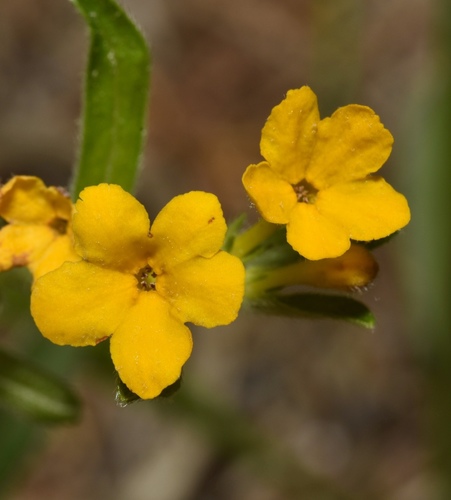
Lithospermum canescens (Michx.) Lehm. reaches 6–16 inches (150–410 mm) in height, and grows from a thick, red, woody taproot. It produces one to several stems that are usually unbranched. Its leaves are alternate, oblong, and lack a petiole. Leaves measure 1–2 inches (25–51 mm) long, with any width under 0.5 inches (13 mm). Both leaves and stems are grey-green and pubescent, covered in many short, silky, erect hairs (trichomes). The flowers are tubular, clustered in terminal racemes at the ends of stems. They are typically yellow to orange in color, and measure about 0.5 inches (13 mm) in diameter. The plant’s fruit is a hard, smooth, yellowish-white seedlike nutlet.
Lithospermum canescens most commonly grows in dry to moderately moist soils in prairies, woodlands, and road edges, and it seldom grows in sandy soils. It is native to the United States ranging west to Nebraska, south to Texas, east to New York, and north to the Canadian border. In Canada, it is native to Saskatchewan, Manitoba, and Ontario.
The common name of this species is hoary puccoon, referencing a traditional use by Native American children, who chewed this plant along with their gum to dye the gum red. The plant’s taproot produces a reddish-purple juice that is commonly used as a pigment. Native Americans also used the roots of this plant to treat asthma and other lung complaints, and as a sedative. The Menomini peoples used the plant’s ripened white seeds as ceremonial beads.