About Lissotriton montandoni (Boulenger, 1880)
Scientific Name and Size
The Carpathian newt, scientific name Lissotriton montandoni (Boulenger, 1880), reaches an average total length of about 10 cm (4 in), with females typically larger than males.
Skin Texture
Terrestrial individuals have granulated skin, while more aquatic individuals have smoother skin.
Head and Body Shape
Three grooves are present on the head, and the body has a very square cross-section.
Dorsal Coloration
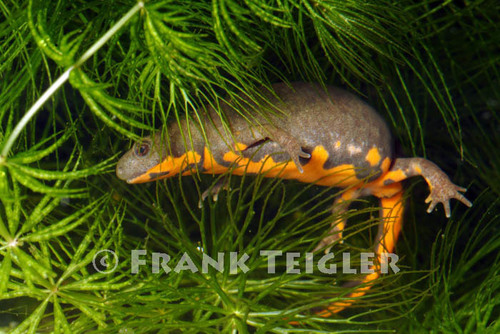
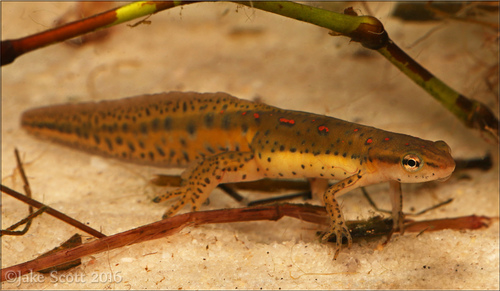
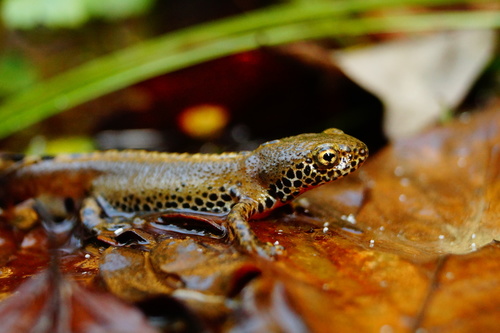
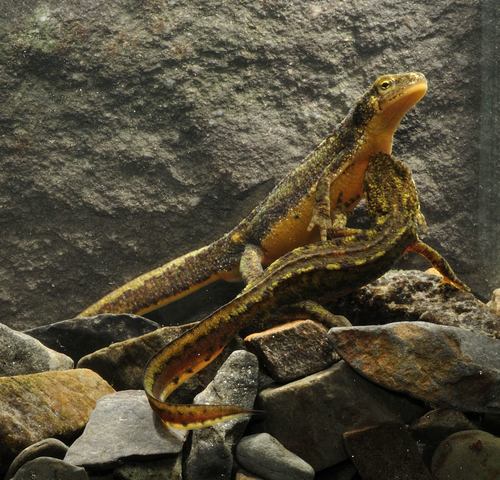
The upper surface is yellowish-brown or olive-brown, heavily marked with fine dark mottled spots.
Ventral Coloration
The underparts are yellow or orange, and often have small black spots along the sides.
Tail Coloration
The lower section of the tail is white or orange with large black spots.
Breeding Season Male Traits
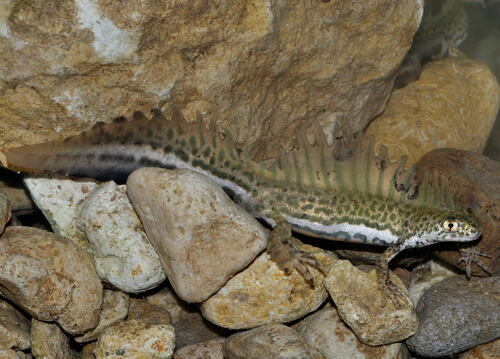
During the breeding season, males develop a slight crest on the tail, a filament at the tail tip, and only a slightly raised ridge along the back.
Native Range and Altitude
This newt is native to the eastern Carpathian Mountains and the eastern Sudetes Mountains, occurring at altitudes up to about 2,000 m (6,562 ft) above sea level.
Introduced Range
It has also been introduced to the Bavarian Forest in Germany.
Hybridization
Where the range of the Carpathian newt overlaps with that of the smooth newt (Lissotriton vulgaris), the two species often hybridize, producing offspring that look intermediate between the two parent species.
Terrestrial Habitat
The Carpathian newt favors wet, shady woodland (both coniferous and broadleaf), woodland glades, woodland edges, and upland pastures.
Adaptability and Breeding Habitat
It can adapt partially to degraded habitats, and breeds in both permanent and temporary bodies of water.