About Lissanthe strigosa (Sm.) R.Br.
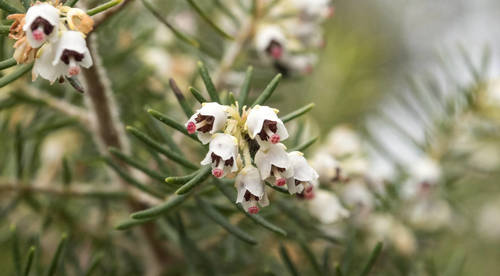
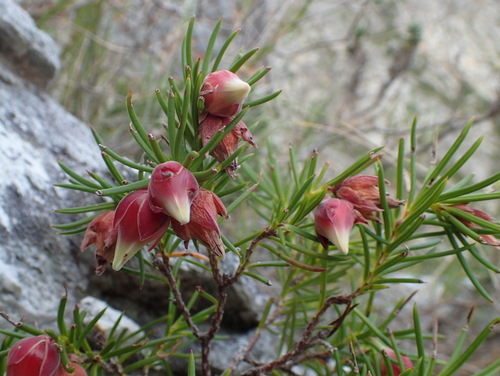
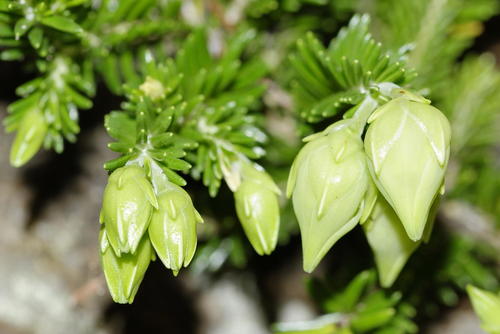
Lissanthe strigosa, also commonly called peach heath, is a heavily branched shrub that grows between 10 cm and 100 cm tall. It often produces suckers, and its small branchlets are covered in tiny bristles. The leaves are linear to lance-shaped, measuring 6.5 to 13.9 mm long and 0.7 to 2.0 mm wide, attached to stems via a petiole 0.8 to 1.3 mm long. There are three distinct longitudinal ribs on the lower surface of the leaves. Flowers are arranged in racemes holding 5 to 9 individual flowers, with 0.8 to 1.0 mm long bracteoles at the base of each flower. Sepals measure 1.1 to 1.2 mm long. Petals are white or pink, joined at the base to form a roughly hairless tube 3.5 to 4 mm long, with lobes 1.5 to 2.4 mm long. The style is 2.6 to 3.1 mm long, covered in soft hairs near its base. Flowering takes place from August to November, and the resulting fruit is a flattened spherical fleshy white capsule 2.5 to 2.9 mm long. Peach heath is widely distributed across Queensland, Victoria, Tasmania and South Australia, growing in forest, scrub, and heath habitats on sandy soils. The subspecies Lissanthe strigosa subsp. strigosa is restricted to the Central Coast of New South Wales, where it grows in poorly-drained clay soils. Lissanthe strigosa subsp. subulata occurs in eastern New South Wales, extending as far west as the Pilliga forest, and also grows in Queensland, Victoria, Tasmania and South Australia.