About Liriope spicata Lour.
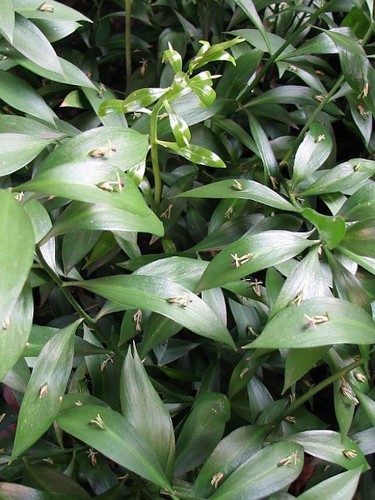
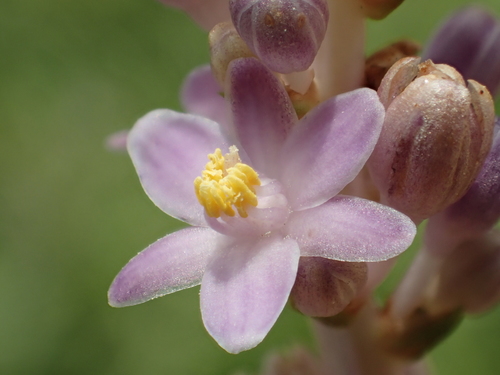
Creeping lilyturf, scientifically named Liriope spicata Lour., is a rhizomatous, grass-like perennial. It forms clusters of narrow, arching, glossy, dark green leaves that reach up to 1⁄4 inch (0.64 cm) wide, and the plant typically grows 9 to 15 inches (23 to 38 centimeters) high. In late summer, erect flower spikes holding small white to pale lavender flowers emerge, and these spikes stay somewhat hidden among the leaves. Blackish berries develop in fall and often persist through the winter. Its roots have prominent rhizomes and frequent tubers, and a variegated-leaf cultivar of this species exists. Creeping lilyturf looks very similar to another common species in the Liriope genus, lilyturf (Liriope muscari). It can be distinguished from lilyturf by three key traits: its rhizomatous root system, in contrast to lilyturf’s diffused root system; its less prominent flower spike that sits partially within the leaves, while lilyturf has a longer spike that extends well above foliage; and its generally narrower and shorter leaves compared to lilyturf. Creeping lilyturf is a native understory plant of China and Vietnam, where it grows in forests and grassy slopes at elevations from sea level up to 5,900 feet (1,800 meters). This species grows easily in average, medium, well-drained soils, and tolerates sites from full sun to part shade. While moist, fertile soils with partial shade are ideal for it, creeping lilyturf also tolerates a wide range of light and soil conditions, as well as heat, humidity, and drought. Its evergreen foliage often turns brown in late winter; old foliage can be cut back or mowed at a high setting before new shoots emerge in early spring. It is suitable for cultivation in USDA zones 4 to 10. Creeping lilyturf is mainly used in mass plantings as a groundcover. Its aggressive spreading tendency means it is generally unsuitable as a border plant, and it has been observed growing rhizomes beneath concrete borders. It is an excellent choice for planting on steep slopes that need erosion control, and requires minimal maintenance. In Chinese medicine, Liriope spicata is used as a substitute for mondo grass (Ophiopogon japonicus) as an herb to treat yin deficiency.