About Liriodendron tulipifera L.
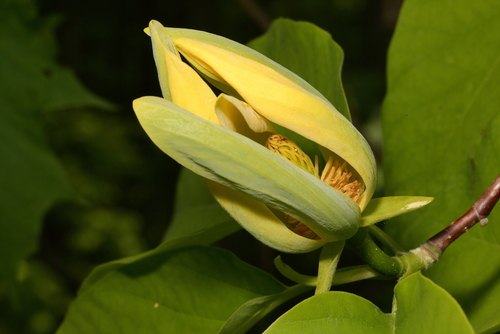
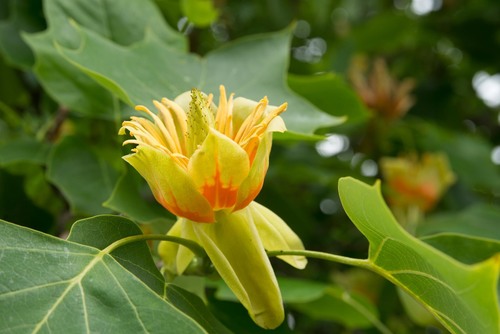
Liriodendron tulipifera L., commonly called the tulip tree, is one of the largest native tree species of eastern North America. Exceptionally tall known specimens reach 58.5 m (192 ft), while the next tallest known individuals reach heights between 52 and 54 m (170–177 ft). These heights are comparable to those of the very tallest known eastern white pines, a species often described as the tallest native tree in eastern North America. On large mature tulip trees, trunks are typically 1.2–1.8 m (4–6 ft) in diameter, though they can grow much wider. The ordinary height range for mature tulip trees is 24–46 m (80–150 ft), and the species tends to develop a pyramidal crown. It prefers deep, rich, moderately moist soil, and is common throughout the Southern United States. Tulip tree growth is fairly rapid. Its bark is brown, furrowed, aromatic and bitter. Branchlets are smooth and lustrous, starting out reddish, maturing to dark gray, and eventually turning brown. The wood ranges from light yellow to brown, with creamy white sapwood; it is light, soft, brittle, with a fine, straight grain. Its specific gravity is 0.4230, and its density is 422 g/dm³ (26.36 lb/cu ft). Winter buds are dark red, covered in a waxy bloom, and obtuse; bud scales become conspicuous stipules that remain attached to unfolding new leaves until leaves reach full size. Flower buds are enclosed in a two-valved, caducous bract. Leaves are alternate, simple, and pinnately veined, measuring 125–150 mm (5–6 in) in both length and width. Leaves have four lobes, with a heart-shaped, truncate, or slightly wedge-shaped base, smooth unbroken margins, and a shallow angled cut across their apex that makes the upper portion of the leaf look square. The midrib and primary veins are prominent. When leaves first emerge from buds, they are curved downward because the petiole bends near its middle to position the apex of the folded leaf at the base of the bud. New leaves are light green; once fully grown, they are bright green, smooth, and shiny on their upper surface, and paler green on their lower surface with downy veins. In autumn, leaves turn a clear, bright yellow. Petioles are long, slender, and angled. Flowering begins in April in the Southern United States; trees at the northern limit of cultivation start flowering in June; flowering also occurs in May. Flowers are perfect, solitary, terminal, and borne on stout peduncles that are 40–50 mm (1+1⁄2–2 in) long. They are cup-shaped, erect, and conspicuous. Flower buds are enclosed in a sheath of two triangular bracts that fall off as the blossom opens. Sepals are three, imbricate in the bud, reflexed or spreading, somewhat veined, and shed early. The corolla is cup-shaped, made of six petals 50 mm (2 in) long arranged in two rows, imbricate and hypogynous. Petals are greenish yellow, marked with yellow toward the base, and somewhat fleshy in texture. Stamens are numerous, arranged in imbricate multiple ranks at the base of the receptacle; filaments are thread-like and short; anthers are extrorse, long, two-celled, and adnate, with cells that open longitudinally. Pistils are numerous, arranged imbricately on the long slender receptacle, with a one-celled ovary, an acuminate flattened style, a short one-sided recurved stigma, and two ovules. Flowers are pale green or yellow (rarely white), with an orange band on the tepals, and produce large quantities of nectar. Fruit is a narrow light brown cone formed from many overlapping samaras. Samaras are dispersed by wind, leaving the central cone axis persistent through the winter. Fruit matures in September and October. Harriet Louise Keeler published a description of the tulip tree in Our Native Trees and How to Identify Them. During the Cretaceous period, the genus Liriodendron included multiple species that were widely distributed across North America and Europe. Fossil remains of the genus are also found in Tertiary rock formations. Today, Liriodendron tulipifera is one of the largest and most valuable hardwood species of eastern North America, thriving in temperate deciduous forests east of the Mississippi River. Its pattern of indeterminate continued growth late in the growing season can make the species more susceptible to drought, and causes trees to stop shoot growth after July in drier climates. It prefers mesic to moist, well-drained soils and is generally most common at low to mid elevations; for example, it is usually not found above 3000 ft (900 m) elevation in Virginia. It is native from southern Ontario and northern Ohio south to the Gulf of Mexico, and from extreme southern New York and Connecticut south to Louisiana and northern Florida. It extends south as far as north Florida, and has very few natural populations west of the Mississippi River, but it occurs occasionally as an ornamental planted outside its native range, and sometimes escapes cultivation. The species reaches its finest development in the Southern Appalachian Mountains, where trees may grow taller than 50 m (170 ft). In 1974, 75 percent of all yellow-poplar growing stock was located in the Appalachian Mountains and adjacent Piedmont stretching south from Pennsylvania to Georgia. It was introduced into Great Britain before 1688 to Bishop Compton's garden at Fulham Palace, and is now a popular ornamental tree for streets, parks, and large gardens. Liriodendron tulipifera is generally considered a shade-intolerant species that is most common in the first century of forest succession. In Appalachian forests, it is a dominant species during the 50–150 year stage of succession, but is absent or rare in forest stands that are 500 years old or older. One group of tulip trees survived on the grounds of Orlagh College, Dublin for 200 years before they were cut down in 1990. On mesic, fertile soils, tulip trees often form pure or nearly pure stands. It can persist in older forests when there is enough disturbance to create large enough gaps for new regeneration. Individual tulip trees are known to live up to around 500 years. All young tulip trees and most mature specimens are intolerant of prolonged flooding; however, a coastal plain swamp ecotype in the southeastern United States is relatively tolerant of flooding. This ecotype can be recognized by its blunt-lobed leaves, which may have a red tint. Liriodendron tulipifera produces large amounts of seed, which is dispersed by wind. Seeds typically travel a distance equal to 4–5 times the height of the parent tree, and remain viable for 4–7 years. Seeds are not one of the most important food sources for wildlife, but they are eaten by a variety of birds and mammals. Vines, especially wild grapevines, are extremely damaging to young tulip trees. Vines harm young trees both by blocking sunlight, and by adding extra weight to limbs that can cause the trunk to bend and/or limbs to break. Liriodendron tulipifera is cultivated, and grows readily from seeds. Seeds should be sown in fine soft soil in a cool shady area. If sown in autumn, seeds germinate the following spring; if sown in spring, they often remain dormant in the ground for a year before germinating. John Loudon noted that seeds collected from the highest branches of old trees are most likely to germinate. The species can be readily propagated from cuttings and is easily transplanted.