About Lipotriches australica (Smith, 1875)
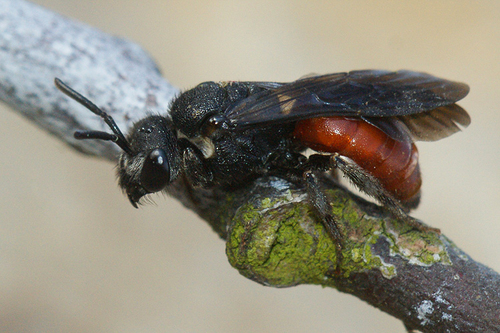
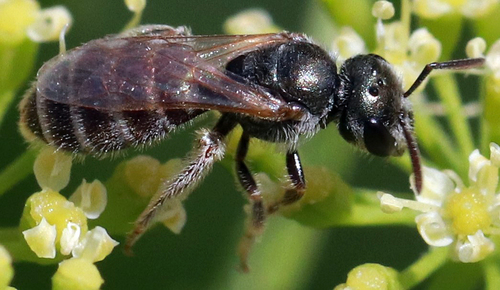
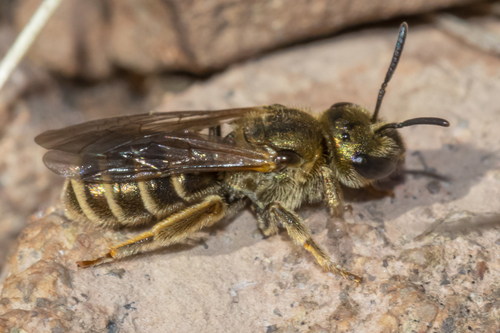
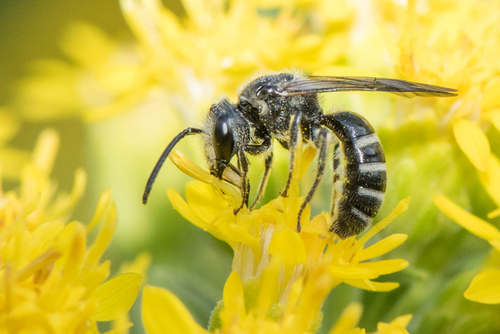
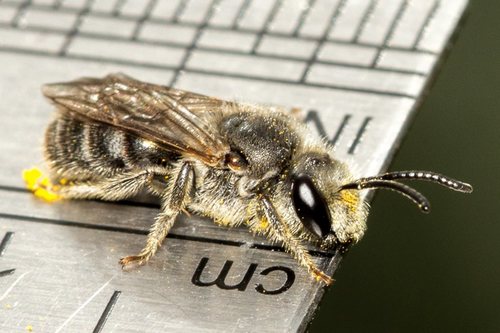
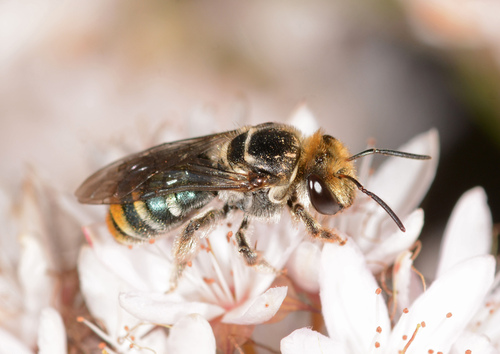
Lipotriches australica (Smith, 1875) is roughly 10 millimeters long, about the size of a European honeybee. Its head and thorax are black, with a patch of short white hair at the rear of the thorax. The abdomen has broad bands of golden hair, and the first few abdominal segments have a metallic blue-green sheen. The hair color of this species can vary based on the individual's age and location. Its wings are semi-transparent, with a faint clouded appearance near the tips. Males have a narrower abdomen than females, and also have modified hind legs: the tibia is expanded and angular, while the femur is swollen. This modification is thought to help males grasp females during copulation. L. australica is abundant and widely distributed across mainland Australia; it has been recorded in all Australian states and territories except Tasmania. L. australica is a buzz pollinator that visits many different flowering plant species. Males are often found clustered together in roosting aggregations. Nests of this species are dug into soil, and made up of a vertical burrow that leads to one or more cavities holding clusters of brood cells. Up to three females may share a single nest, but each female builds and supplies her own brood cells. Each cell is lined with a waterproof secretion, and holds one egg along with a store of nectar and pollen. Females have been observed taking turns guarding the nest entrance. When a nestmate wants to enter, the guarding female retreats to a small chamber just below the entrance. The guard blocks the entrance with her head during the day, and with her abdomen at night. When adults are active, a low mound of soil often surrounds the burrow entrance. During the cooler inactive months, the burrow is closed with a plug of soil. When conditions are favorable, females will nest in dense aggregations that can contain tens of thousands of nests per hectare. A nest site may be used for several years, as successive generations clean debris out of old brood cells to reuse them. In Victoria, this species is active between September and April, with peak activity occurring in February.