About Liparis reflexa (R.Br.) Lindl.
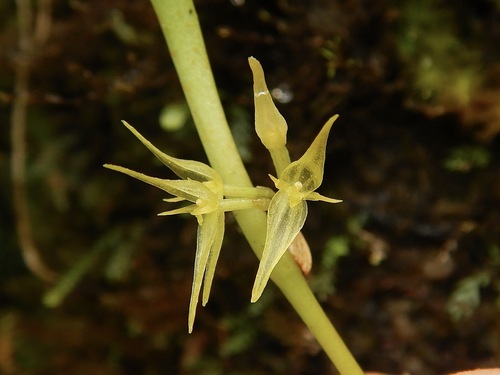
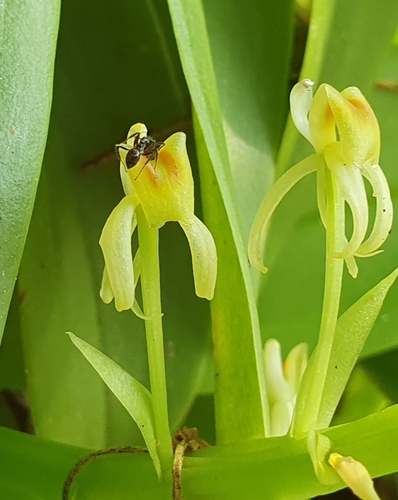
Liparis reflexa (R.Br.) Lindl. is most commonly a lithophytic herb, and only rarely grows as a terrestrial herb. It has more or less oval pseudobulbs that measure 20–40 mm (0.8–2 in) long and 15–30 mm (0.6–1 in) wide. This species produces up to four linear to lance-shaped leaves, which range in color from dark to yellowish green. The leaves are 100–300 mm (4–10 in) long, 10–15 mm (0.4–0.6 in) wide, and folded lengthwise. Between five and thirty or more yellowish green flowers are borne on a flowering stem that is 100–300 mm (4–10 in) long. Individual flowers are 10–15 mm (0.4–0.6 in) long and 8–10 mm (0.3–0.4 in) wide, and have an odor described as similar to urine or a wet dog. Each flower has a pedicel (including the ovary) that is 6–16 mm (0.2–0.6 in) long. The sepals are 7–10 mm (0.3–0.4 in) long and about 2 mm (0.08 in) wide, while the petals are a similar length to the sepals but only about 1 mm (0.04 in) wide. The labellum is 7–10 mm (0.3–0.4 in) long and 3–4 mm (0.1–0.2 in) wide, and curves downward and backward on itself. Flowering of Liparis reflexa takes place between February and June. In terms of distribution and habitat, Liparis reflexa usually grows on rocks, including on escarpments and boulders in gorges, and only rarely grows on trees. It occurs in the region between the Clyde River, Hastings River and Hunter River valleys.