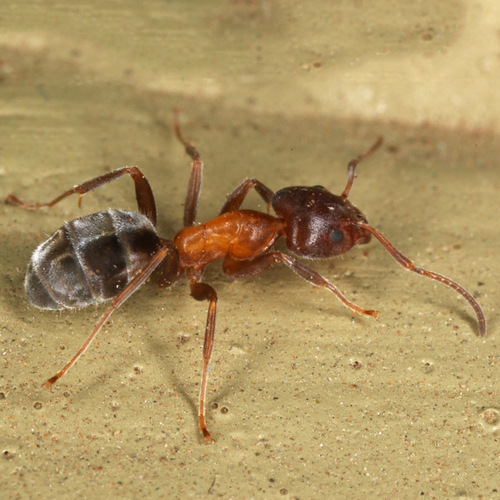
About Liometopum occidentale Emery, 1895
Liometopum occidentale Emery, 1895, commonly known as the velvety tree ant, is an ant species belonging to the subfamily Dolichoderinae. Both homeowners and pest management professionals often confuse Liometopum occidentale with carpenter ants of the genus Camponotus. This confusion arises from morphological and behavioral traits the species shares with carpenter ants: specifically, it has polymorphic workers, a smooth convex thoracic profile, and a tendency to excavate wood. Because of this frequent misidentification, Liometopum occidentale’s status as a structural pest is likely greatly underreported, particularly in the U.S. states of California, Oregon, and Washington. Liometopum occidentale occurs in coastal regions stretching from southern Washington to northern Mexico, at elevations ranging from sea level to over 1840 meters. The species’ elevation range correlates with latitude: populations in Oregon have been collected as low as 7 meters, while populations in California have been found up to 1700 meters. It is the most common and dominant ant species in oak and pine forests of the southwestern United States. It prefers to nest in crevices of oak, alder, elm, cottonwood, and creosote plants, in soil, and under the bark of dead trees. Nuptial flights of reproductive Liometopum occidentale have been observed throughout the month of May. A mature colony of this species, which contains between 40,000 and 60,000 workers, produces an annual brood biomass of 2 to 2.8 kilograms per year, over a colony lifespan of 4 to 8 years. Workers kept without a queen will also lay unfertilized eggs; these eggs are either eaten by the colony or develop into adult males.