About Liodytes rigida (Say, 1825)
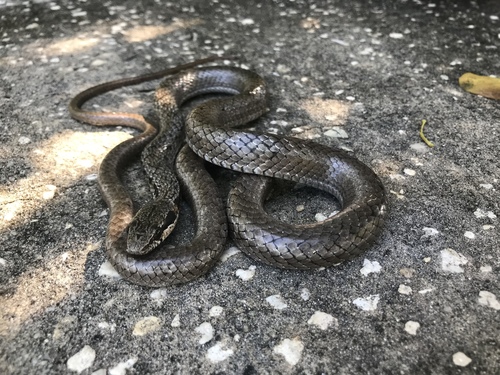
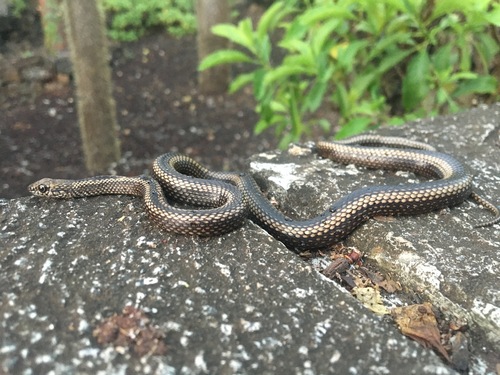
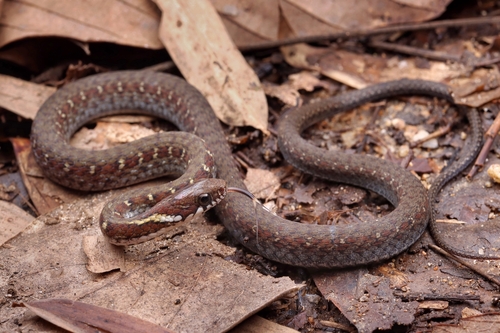
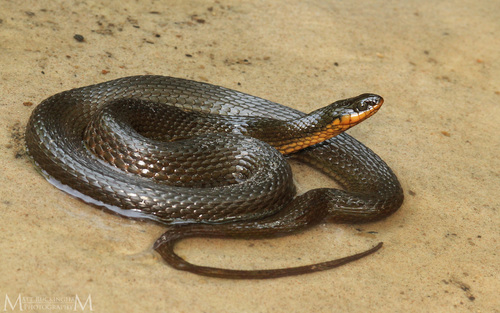
Adult Liodytes rigida have an average total length (including the tail) of 16 inches, which is approximately 41 cm, and they have heavy bodies. The maximum recorded total length for this species is 31 and 3/8 inches, equal to 80 cm. The dorsal surface of L. rigida is olive brown, and it may or may not have two blackish dorsal stripes. Its upper lips, formed by the labial scales, are yellow. The ventral surface is yellow with two parallel rows of black spots that merge into a single row towards the anterior end. The underside of the tail may either have a median black line or be unmarked. At midbody, the dorsal scales are arranged in 19 rows. Most dorsal scales are strongly keeled, with the exception of the first two rows: the first row, adjacent to the ventral scales, is completely smooth, and the second row is weakly keeled. This species has between 132 and 142 ventral scales, a divided anal plate, and between 51 and 71 divided subcaudal scales. Liodytes rigida occurs on the coastal plains of both the Atlantic Coast and Gulf Coast, within the U.S. states of eastern Texas, southeastern Oklahoma, southern Arkansas, Louisiana, southern Mississippi, southern Alabama, northern Florida, southern Georgia, eastern South Carolina, and southeastern North Carolina. A separate, disjunct population of L. rigida is also found in eastern Virginia. L. rigida is viviparous, meaning it gives birth to live young.