About Liodytes alleni (Garman, 1874)
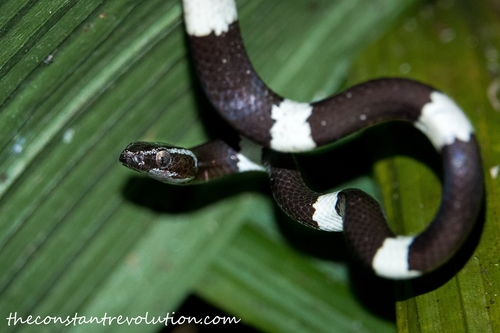
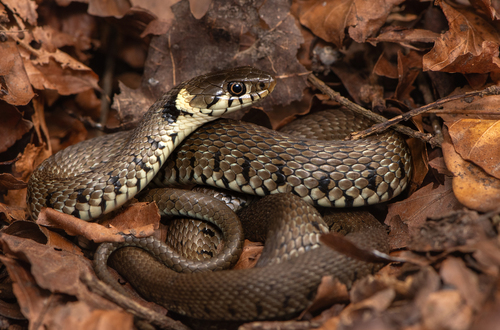
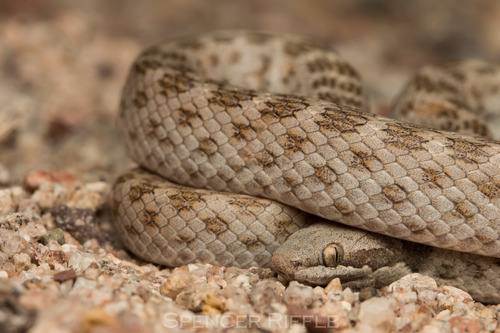
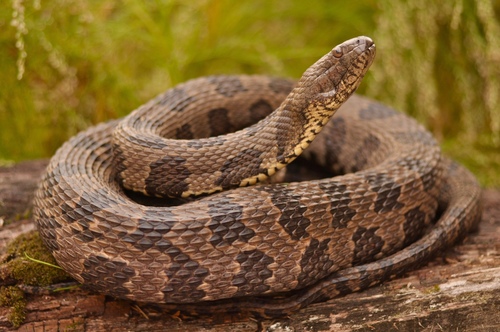
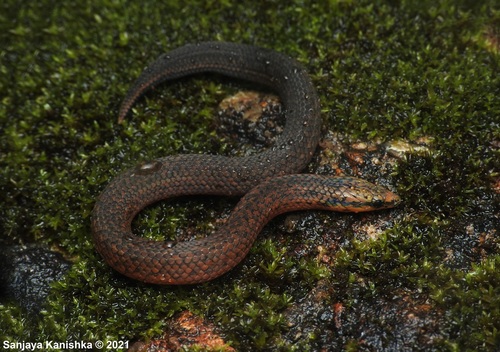
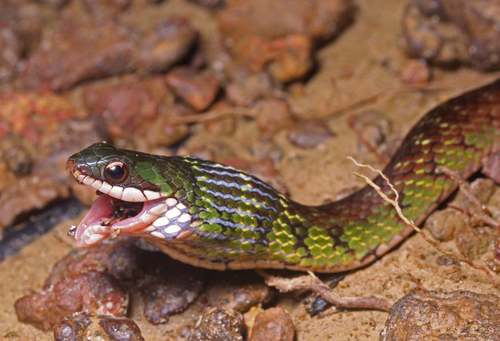
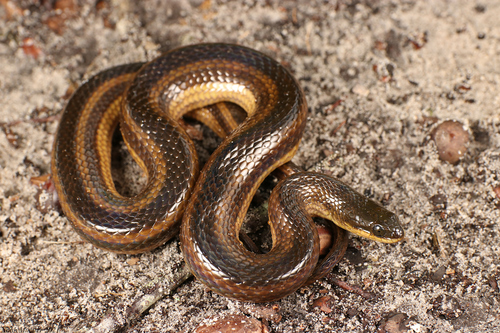
The striped crayfish snake (Liodytes alleni) is a small-to-medium sized snake with a heavy body, reaching a total length (including tail) of 33 to 50 centimetres (13 to 20 inches). The faint stripes that give the species its common name sit along its dark upper (dorsal) side. Its underside (ventral side) is yellow with scattered dark spots. Dorsal scales are arranged in 19 rows at midbody; they are smooth across most of the body, with some keeled scales present in the anal region. This species displays clear sexual dimorphism, with females growing larger than males. The striped crayfish snake is very similar to the closely related glossy crayfish snake (Liodytes rigida rigida), but can be distinguished by having just one row of dark spots on its underside, while the glossy crayfish snake has two rows. The striped crayfish snake is a semiaquatic species that is regularly found in swamps, open wetlands with dense plant growth, cypress swamps, saw grass prairies, and roadside ditches. It has adapted well to grow in dense water hyacinth beds that have invaded many local waterways. Though it is an aquatic species, it is almost never found in flowing moving water. Its range is centered primarily in Florida, where it is common across areas east of the central panhandle; it also occurs in southeastern Georgia, with the northern edge of its range lying near the Florida-Georgia border. Very little research exists on the reproduction of the striped crayfish snake. It is thought that adult snakes mate in spring, and give birth to live young in late summer or autumn. Broods contain between four and twelve newborn (neonate) snakes, and larger adult females typically produce more offspring than smaller adults.