About Linepithema humile (Mayr, 1868)
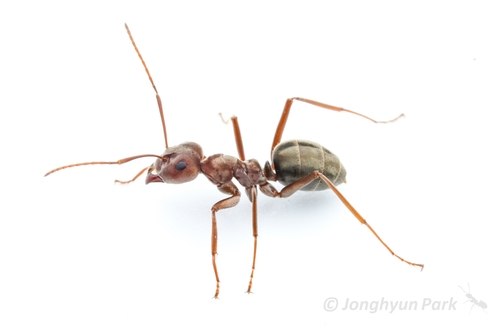
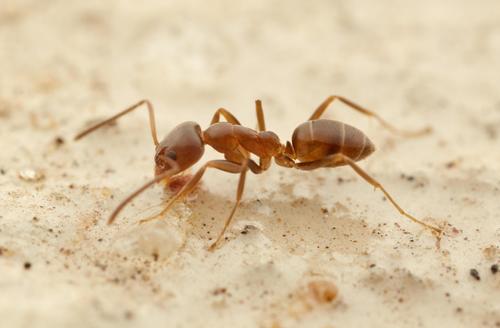
Linepithema humile, the Argentine ant, is a small ant species that ranges 2.2–2.6 mm in body length, with a dull color that goes from light to dark brown. In areas where this species has invaded, its ant colonies are very large: they contain many workers and multiple queens. Argentine ants have opportunistic nesting preferences. Their colonies have been found nesting in the ground, in cracks in concrete walls, in gaps between boards and timbers, and even among personal belongings inside human homes. In natural areas, they usually nest shallowly, in loose leaf litter or under small stones, because they cannot dig deeper nests well. However, if a deeper nest is abandoned by another ant species, Argentine ant colonies will readily take over this empty space. Because this species’ native habitat is riparian floodplains, Argentine ant colonies are very sensitive to water entering their nests. If a nest becomes fully inundated with water, workers will collect the colony’s brood, and the entire colony will move to dry ground. Austrian entomologist Gustav L. Mayr first identified specimens of this species (originally named Hypoclinea humilis) near Buenos Aires, Argentina in 1866. Shortly after identification, this species was moved to the genus Iridomyrmex, and it was finally transferred to the genus Linepithema in the early 1990s. The native range of Argentine ants is restricted to riparian lowland habitats within the Paraná River drainage, which spans across northern Argentina, Uruguay, Paraguay, and southern Brazil. Within South America, the species has spread to parts of Chile, Colombia, Ecuador, and Peru. Linepithema humile grows well in Mediterranean climates, and over the past century it has spread across the globe through human-mediated transport. It has become established on every continent except Antarctica, and on many oceanic islands. Like workers of many other ant species, Argentine ant workers cannot lay reproductive eggs, but they can control how eggs develop into reproductive females. The production of males seems to be controlled by the amount of food available to larvae. Almost all Argentine ant colonies have multiple reproductive queens, with as many as eight queens per 1,000 workers. Colony size and reproductive activity reach a seasonal low in mid-winter. At this point, 90% of a typical colony is made up of workers, with the rest being queens; there is no reproductive activity, and very few new ants are born. Egg production begins in late winter, and almost all of these eggs develop into sexual reproductive forms by May. Mating takes place after new females emerge. Worker production increases steadily from mid-March to October, after which no new workers are produced to replace dying ones. As a result, worker numbers drop steadily through the winter months. Note: the timing for the months of May, March, and October given in this paragraph, as well as the entire month axis for associated graphs, is not correct worldwide, especially in the Southern hemisphere, because seasons are shifted six months between the two hemispheres. In the species’ native habitat, colonies are confined to territory between 10 and 100 meters across, limited by competition from rival colonies of other ant species and rival Argentine ant colonies. As colonies expand, they form fluctuating territory borders that expand and contract based on seasonal conditions and other factors. Colonies push their territory outward expansively in the summer, and retreat in the winter. This seasonal pattern is tied to soil moisture and temperature conditions. The edges of colony territories are stopped by either rival L. humile colonies or other barriers that prevent further expansion, such as environments that are unsuitable for nesting.