About Linaria purpurea (L.) Mill.
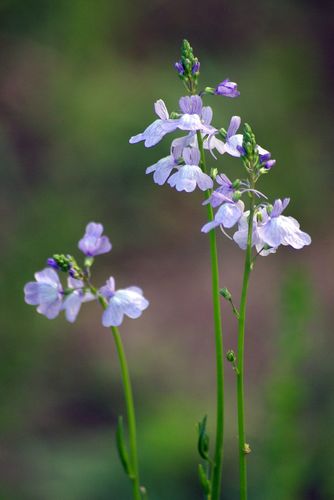
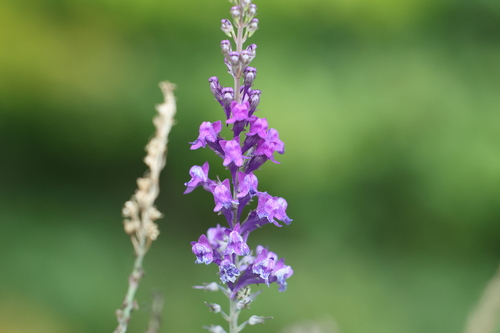
Linaria purpurea (L.) Mill. is a perennial herbaceous plant that grows 30 to 70 centimeters tall, with linear leaves measuring 2 to 5 centimeters in length. The inflorescence is a raceme of flowers that grows at the top of the stem. Individual flowers are between 1 and 2 centimeters long, with five lobes arranged into two lips and a spur at the end. Flowers are usually light to medium purple in color, and the fruit is a capsule. A pale pink cultivar of this species is named 'Canon Went'. This species is native to Italy, but it grows wild as an introduced species in parts of western North America, including California, western Washington, and British Columbia. It is cultivated as an ornamental plant. In its native range, it occurs naturally in moist, moderately nutrient-rich locations. In the UK, it is considered somewhat of a weed that spreads readily on stony waste ground and walls, but it is often tolerated for its attractive, long-lasting flowers, which are very attractive to bees. This plant is poisonous to livestock, though ruminants generally tend to avoid eating it. The larvae of some Lepidoptera (butterfly) species use this plant as a food source. A recent study conducted in Italy found that the plant contains a compound with antifungal activity, which drastically reduces production of aflatoxin B1 in Aspergillus flavus Link. This finding makes it a potential natural, 'green' anti-aflatoxin B1 agent suitable for use in the food industry.