About Linanthus parryae (A.Gray) Greene
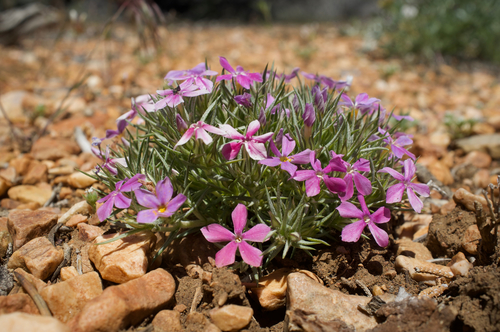
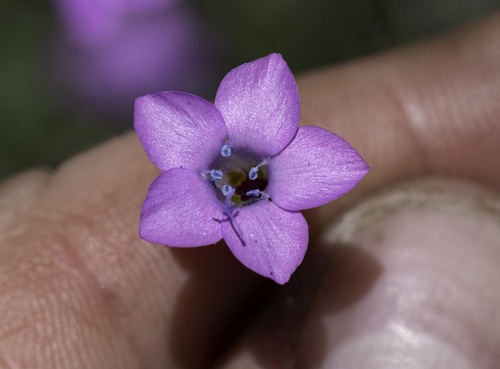
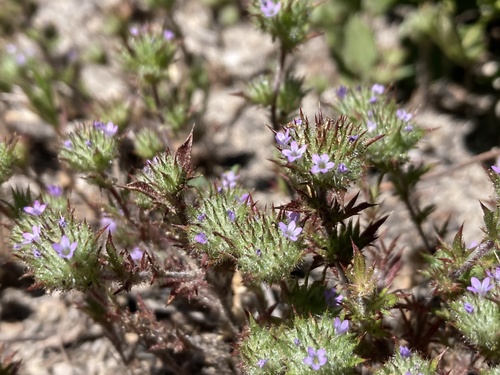
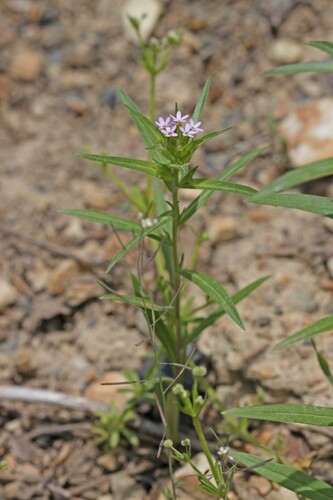
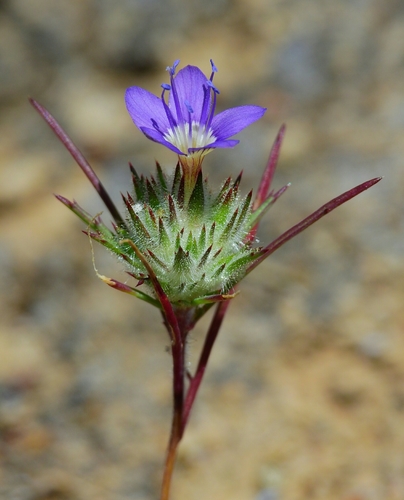
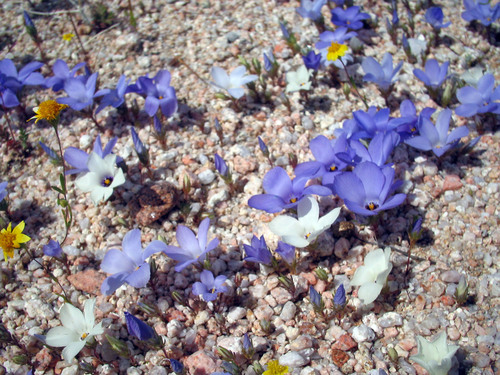
Linanthus parryae is a species of flowering plant in the phlox family, commonly known as sandblossoms. It is native to the western United States; within California, it grows across several regions ranging from the Central Valley to the Sierra Nevada foothills and the Mojave Desert. It grows in sandy, open, flat areas. This is a small annual herb that produces short stems only a few centimeters tall, surrounded by hairy leaves with needle-like lobes. Its inflorescence, which often appears to sit directly on the ground tucked in among the leaves, is a cluster of funnel-shaped flowers about one centimeter wide. The flowers are self-incompatible, and are exclusively cross-pollinated by a Melyrid beetle, Trichochorous sp. Seeds germinate after winter rains between January and February, the plants flower in April, and shed seeds between May and June. Seeds are dispersed passively, remain viable for at least seven years, and have little to no germination during dry years. Flowers of this species may be white, or blue/purple. Flower color is primarily controlled by a single gene locus: the allele for white flowers is recessive, while the alleles for blue flowers are dominant. Most populations have mostly white flowers, some populations are mainly blue-flowered, and others have both blue and white-flowered plants at intermediate frequencies. The proportion of each color remains quite stable over time, and some locations have sharp transitions between populations dominated by blue flowers and those dominated by white flowers. This unusual phenomenon has made this species a model organism for studies of genetic variation. For many decades, a long series of geneticists and botanists including Sewall Wright, Carl Epling, Harlan Lewis and T. G. Dobzhansky have studied populations of this flower to identify factors that influence this color polymorphism. Color frequencies may vary for many reasons, including genetic drift and straightforward natural selection. Wright developed his isolation by distance and Shifting Balance theories based on studies of genetic drift in this flower, using data collected by Epling and Dobzhansky in the Mojave Desert. More recent studies place greater emphasis on the effects of natural selection on flower color frequency.