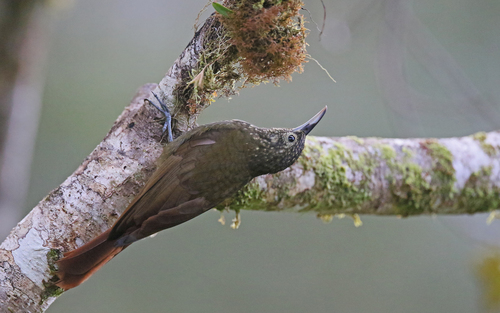
About Limnornis rectirostris Gould, 1839
The straight-billed reedhaunter (scientific name Limnornis rectirostris Gould, 1839, also referenced as Limnoctites rectirostris) is a South American bird species belonging to the Furnariidae family. This species is distributed across northeastern Argentina, southeastern Brazil, and Uruguay. Throughout its range, it is almost entirely restricted to marshy areas in pampas and campos, ranging from coastal lowlands to highlands. In Brazil, it occurs in Rio Grande do Sul and Santa Catarina States. In Argentina, it can be found in Entre Ríos Province and the extreme northeast of Buenos Aires Province. In Uruguay, it is limited to the eastern and southern regions of the country. In recent years, it has been recorded in Cerro Largo, Canelones, Maldonado, Rocha, San José, and Treinta y Tres Departments; Charles Darwin first found it in 1833 at Laguna José Ignacio and Laguna del Diario in Maldonado, where the species can still be found today, and it occurs especially at Quebrada de los Cuervos in Treinta y Tres. There is only a 1994 record of the species from Lavalleja Department, but it likely still persists there. This straight-billed reedhaunter prefers marshy and swampy habitats between sea level and 1,100 m above sea level. A key characteristic of its prime habitat is abundant growth of caraguata (spiny eryngos, Eryngium spp.), particularly E. pandanifolium, which the species uses especially in upland localities. It has sometimes been stated that the two reedhaunter species have different microhabitat preferences, occurring in the same broader region (sympatrically) but not in the same exact locality, but this claim appears to be incorrect.