About Limnanthes douglasii R.Br.
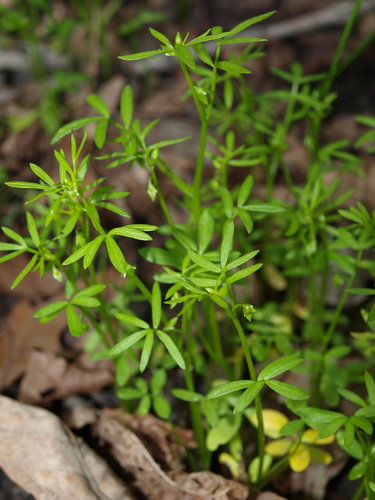
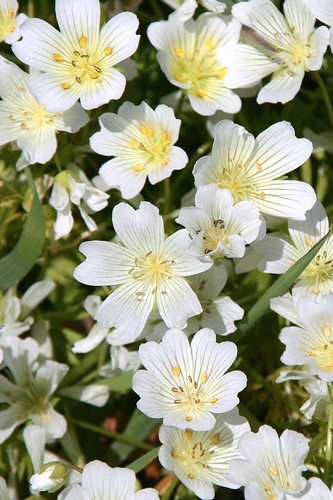
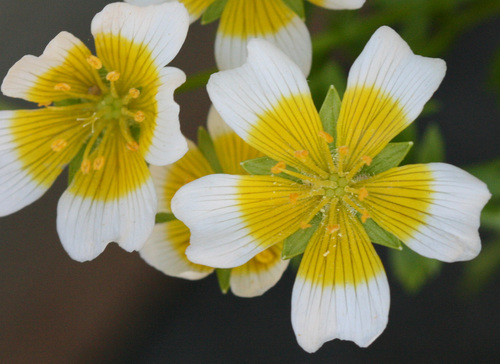
Limnanthes douglasii R.Br. is an annual flowering plant in the meadowfoam family Limnanthaceae, commonly called Douglas' meadowfoam or poached egg plant. It is native to California and Oregon in the United States, where it grows in wet, grassy habitats including vernal pools and spring meadows, and can tolerate poorly drained clay soils. This species was first collected by Scottish explorer and botanist David Douglas, who conducted botanical work on the west coast of North America in the 1820s. Most individuals produce white flowers with yellow centers, which gives the species its common name "poached egg plant", but flower color varies between recognized subspecies. It is a widely popular ornamental plant, attracts hoverflies, and is pollinated by bees. It is self-seeding, and can successfully self-seed even when grown in lawns. This plant has been awarded the Royal Horticultural Society's Award of Garden Merit. Six subspecies are currently recognized: L. douglasii subsp. douglasii R. Br. is native to coastal mountains and valleys from southwestern Oregon south to the San Francisco Bay Area; L. douglasii subsp. nivea (C.T. Mason) C.T. Mason produces mostly white flowers and grows in the coastal mountains of northern California; L. douglasii subsp. ornduffii (E. G. Buxton) has four petals instead of five, and is endemic to San Mateo County, California; L. douglasii subsp. rosea (Benth.) C.T. Mason is found in California's Central Valley and adjacent hills, and often has pink veining on its petals; L. douglasii subsp. sulphurea (C.T. Mason) C.T. Mason is a rare yellow-petaled subspecies endemic to the San Francisco Bay Area; L. douglasii subsp. striata (Jeps.) Morin was recently incorporated into this species, and occurs in the Klamath Range, as well as the northern and central Sierra Nevada. The total number of valid subspecies for this species has been disputed: some botanists argue there are only four subspecies of Limnanthes douglasii, and all currently accepted members of the species are highly polymorphic.