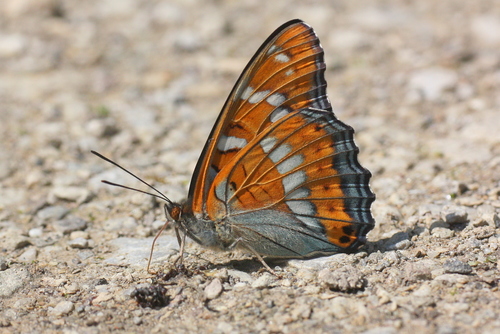
About Limenitis populi (Linnaeus, 1758)
Characteristics The wingspan of prepared spread specimens of Limenitis populi ranges from 66 to 77 mm for males, and from 82 to 85 mm for females. All these measurements were taken from the large private collection of Limenitis populi that is now held by Jean-Claude Weiss, a well-known specialist of Parnassius. In reality, wild-caught specimens from the same location are generally similar in size. Most measured size differences come from variation between different subspecies, rather than high size variability of the species within a single location. Very small specimens, reaching roughly half the typical size, do exist, but these are all captive-bred individuals. There is a clear size difference between the two sexes: females are consistently larger than males. Females also have distinct broad white lines on their hindwings, while on males these lines are narrower and fainter, and sometimes absent entirely. The upper wing surface is dark brown with white spots, and the white stripe is bordered by orange and blue rings. The underside of the wings is orange.
Habitat The Poplar Admiral (Limenitis populi) has a widespread range across continental Europe and large parts of Asia. This large, rarely observed butterfly is one of the biggest butterfly species found in Europe. It inhabits deciduous forests where aspen (Populus tremula) or black poplar (Populus nigra) grow, because its caterpillars feed exclusively on the leaves of these two tree species. At higher altitudes, such as in the Alps where large continuous Populus forests do not occur, the species adapts to small poplar groves. In southeastern France, for example in the department of Alpes-Maritimes, it has been recorded flying in large open areas, as noted by entomologist Jacques Rigout. Males are easier to locate than females. Females are much rarer to encounter, because they typically remain in the upper canopy of trees and rarely descend to the ground.
Distribution This species is confirmed to occur from Denmark south to northern Italy in western Europe, and extends east from Germany through Greece, Russia, China, all the way to Japan. A recorded occurrence in Spain noted by Miguel-Angel Gomez Bustillo is considered doubtful. Jacques Rigout published detailed distribution maps of this butterfly for France, produced by compiling specimen data from the Paris Museum, the British Museum, and capture records from French entomologists. The species' current distribution is smaller than it previously was; for example, it has not been observed in Forêt de Mormal in northern France, where it was once relatively common, for the last 20 years.