About Limenitis doerriesi Staudinger, 1892
This description of Limenitis doerriesi, taken from Seitz, notes that the male is illustrated on plate 57b, while the female shown on that plate is actually Limenitis helmanni ab. duplicata Staudinger; the female of L. doerriesi appears on plate 61d. L. doerriesi is extremely similar to the preceding species L. helmanni, leading to justifiable doubt that it is a distinct species.
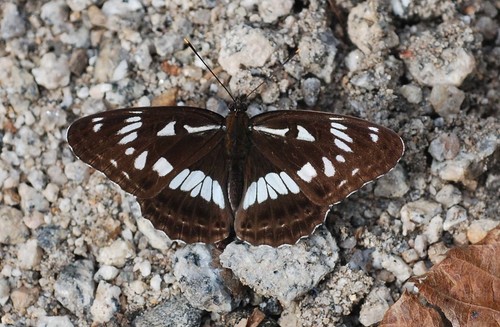
L. doerriesi has a faint reddish-brown stripe at the apex of the forewing cell, which is not shown in available illustrations. Females occasionally also have an additional reddish spot on the anterior side in the center of the cell. Near the distal margin of both wings, adjacent to a row of clearly defined small black spots, there are usually also elongated white spots. These white spots are not present on the illustration of the male, are absent from the anterior area of the forewing, and may become considerably enlarged at the center of the distal margin.
The white spots located between the median veins of the forewing sit slightly closer to the middle of the wing than they do in duplicata, a form of L. helmanni. The inner edge of the white band on the underside of the hindwing is described as a key distinguishing feature from duplicata. In L. doerriesi, this edge projects slightly toward the distal margin below the subcostal, and is completely straight or weakly undulate (concave toward the base) in this area and between the radials. In duplicata, the brownish section of the basal area projects twice in an arc shape into the corresponding white spots of the band.
In males, the rest of the wing underside is almost identical to that of duplicata, but the white band is slightly narrower, and distinct black dots are present in the grey spots of the marginal area. Females are rather larger than males; the outer area of their wing underside is more uniformly ochreous, with white marginal lunules and a row of small elongated white spots contained within a narrow grey band. A black dot sits before each of these white spots, and the anal angle bears a double dot in both males and females. This species is recorded from Sutshan (Ussuri) in Amurland.