About Limenitis arthemis Drury, 1773
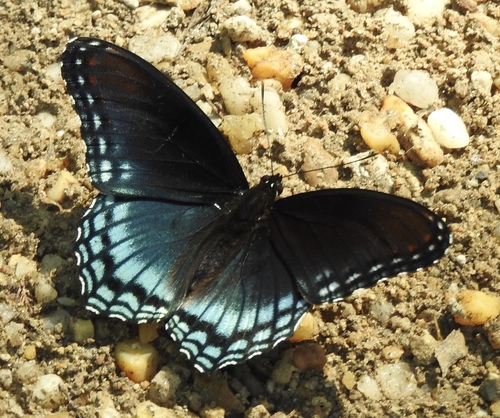
Limenitis arthemis Drury, 1773 is a butterfly species described as beautiful and highly active. This species can be split into two major groups based on one main characteristic: the presence of a white band on the upper wings. L. arthemis individuals are in constant motion; their flights are short, low-altitude, reaching only 2 to 3 feet above the ground. When not flying, they constantly walk over leaves and fold their wings. They prefer sun, so many are found resting at the highest points of trees. During short rest periods, L. arthemis holds their wings closed, their body angled 45 degrees upwards, and their antennae pointing straight forward. The two sexes of this species are identical in appearance except females are slightly larger than males. The upperside of the wings of the subspecies L. a. arthemis is mostly blackish-blue, with white postmedian bands across both wings. Some individuals have a row of red submarginal spots, while others have blue in this area. The underside of the wings is blackish with a broad white post-median band. The basal area of both wings has many red spots. The submarginal area may have a row of red spots, and the marginal area has bluish spots, though sometimes both the submarginal and marginal areas are just reddish-brown. The upperside of L. a. astyanax is very similar to L. a. arthemis, except it lacks the broad white bands. The forewing submarginal area will sometimes have a row of red spots. The hindwings are either bright iridescent blue or iridescent bluish-green. The underside of the wings of L. a. astyanax also lacks the white band. Its basal area has several red spots, and it has a row of red submarginal spots and bluish marginal spots. Limenitis arthemis is widely distributed across North America. The subspecies L. a. arthemis, the white admiral, lives in the far north of the continent, ranging from New England and the southern Great Lakes area across much of Canada. L. a. astyanax occurs further south, below the New England and southern Great Lakes boundary, and can be found as far south as Florida. A hybridization zone exists in the overlapping range of the two subspecies across New England and the southern Great Lakes. These butterflies live in deciduous woodlands, along shaded forest edges, and on roadsides. Their preferred host plants are birches including Betula lenta; species in the Salicaceae family including Salix bebbiana and Populus tremuloides; and Prunus virginiana in the Rosaceae family. Less commonly used host plants include Crataegus, Amelanchier, Malus pumila, Prunus pensylvanica and Prunus serotina (Rosaceae), Populus deltoides, P. grandidentata and P. balsamifera (Salicaceae), Alnus rugosa, Betula alleghaniensis and Carpinus caroliniana (Betulaceae), Ulmus americana (Ulmaceae), Tilia americana (Malvaceae) and Fagus grandifolia (Fagaceae). Limenitis arthemis produces two broods per year between April and October. Most caterpillars of the first brood feed and grow until they are half-grown, then form a hibernaculum and hibernate over winter until early spring. Some larvae are able to mature during the summer, emerging as the second brood in early fall. The second brood mates and lays eggs, but their larvae are often not mature enough to enter hibernation, which can result in death for these immature larvae.