About Lilium washingtonianum Kellogg
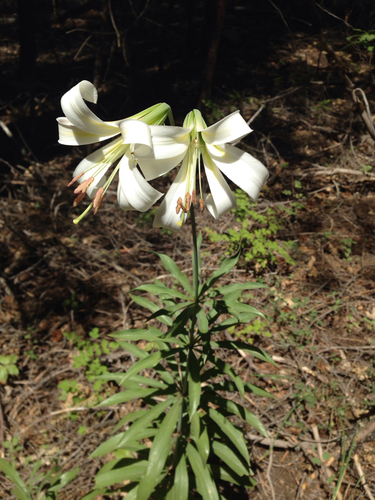
Lilium washingtonianum Kellogg is a lily species that grows 100 to 200 cm tall. It produces 1 to 30 very large, fragrant white or pinkish flowers, which often have purplish spots. Flowers open before dusk and turn purple as they age, and the plant blooms between June and July. Its six tepals are 6 to 9 cm long and do not curve back strongly. Each flower has three carpels, six stamens with yellow anthers and green filaments, and produces seeds that ripen in elongated seed capsules measuring 2.7 to 5.8 cm long. The plant has rounded bulbs covered in white scales that form rhizomes, and these bulbs are very sensitive when dug up. Its stem has a waxy, bluish coating that rubs off easily, creating a frosty appearance. The light green, lance-shaped leaves are 3/4 to 1 1/2 inches wide and 1 1/2 to 5 inches long, arranged in 1 to 8 whorls holding 3 to 16 leaves each. Leaves have sharp tips and distinct visible veins. Seeds germinate via delayed hypogeal germination. Two subspecies are recognized: Lilium washingtonianum subsp. purpurascens (Stearn) M.W.Skinner, whose flowers turn deep pink or lavender as they age, and Lilium washingtonianum subsp. washingtonianum, whose flowers turn pink or white as they age. Lilium washingtonianum is native to the Cascade Range and Sierra Nevada of western North America, and its native range is restricted to the U.S. states of California and Oregon. It typically grows in chaparral, open woods, recently burned areas, and revegetating clearcuts.