About Lilium speciosum Thunb.
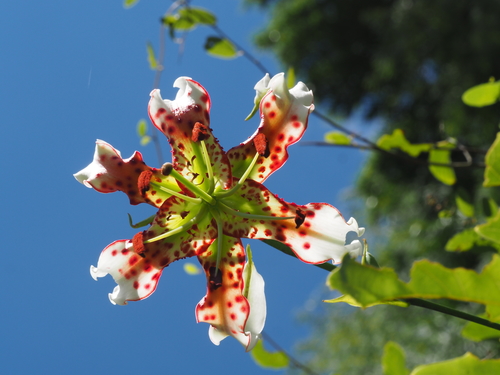
Lilium speciosum Thunb. is an East Asian plant species belonging to the lily family. It is native to southern Japan and southern China, growing at elevations between 600 and 900 metres (2,000–3,000 ft). It is sometimes referred to as the Japanese lily, though this common name is also used for other plant species. This lily grows up to 1.2 metres (3 ft 11 in) tall and reaches 0.3 metres (1 ft 0 in) wide. It blooms from August to September in north temperate regions, flowering later than most other lily species. Its flowers range in color from white to pink and have a strong scent. Many garden forms of Lilium speciosum are in cultivation, and the species has been widely used to breed new garden lily forms. Lilium speciosum contains phenolic glycosides including 6′-O-feruloylsucrose and (25R,26R)-26-methoxyspirost-5-en-3β-ol 3-O-α-l-rhamnopyranosyl-(1→2)-β-d-glucopyranoside, as well as steroidal saponins. There are two recognized varieties: Lilium speciosum var. gloriosoides Baker, which is found in China and Taiwan, and Lilium speciosum var. speciosum, which is native to Japan's Shikoku and Kyushu regions. Lily pollen is toxic to domestic cats, and ingestion of lily pollen is often fatal. Households and gardens that are visited by cats are advised against growing lilies or placing lily flowers in locations where a cat may brush against them, get coated in pollen, and then consume the pollen during grooming. Suspected cases of pollen ingestion require urgent veterinary attention. Prompt treatment with activated charcoal and/or induced vomiting can reduce the amount of toxin the cat absorbs, and administering large amounts of fluid via IV can reduce kidney damage to improve the chances of survival.