About Lilium pyrophilum M.W.Skinner & Sorrie
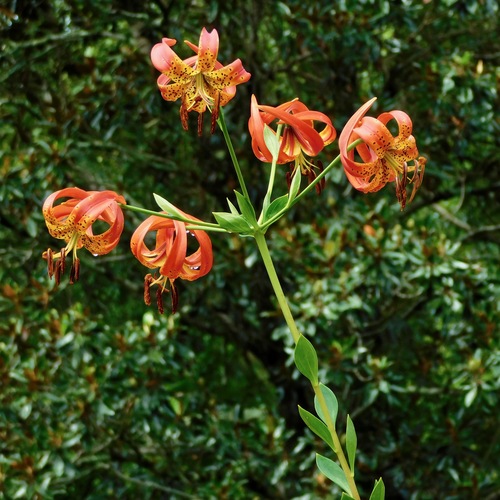
Lilium pyrophilum, commonly called the sandhills lily or sandhills bog lily, is a North American species of lily in the family Liliaceae. It is endemic to the Sandhills region of the eastern United States, found across southern Virginia, North Carolina, and northern South Carolina. This lily grows from a rhizomatous, bulbous root system that is occasionally branched, and reaches a mature height of 0.6 to 1.6 meters. It produces long narrow, slightly pointed leaves arranged in a variable number of whorls around the stem; the leaves may grow upright or droop. Its inflorescence is a raceme holding 1 to 7 yellow or yellow-orange flowers. The individual flowers are pendant, not fragrant, with petals that shift to reddish, reddish-orange, dusky red, or magenta toward the tip, marked with magenta spots, and curled back into a characteristic turks cap shape. The anthers are magenta or purple, and blooming occurs from late July to mid-August. The common name sandhills lily comes from the species' restricted native range, where it benefits from regular brush fires. Lilium pyrophilum is closely related to Lilium superbum, which it can easily be mistaken for, and it is capable of cross-pollinating with Lilium michauxii. Observation suggests that ruby-throated hummingbirds (Archilocus colubris) and Palamedes swallowtail butterflies both act as pollinators for this species.