About Lilium pensylvanicum Ker Gawl.
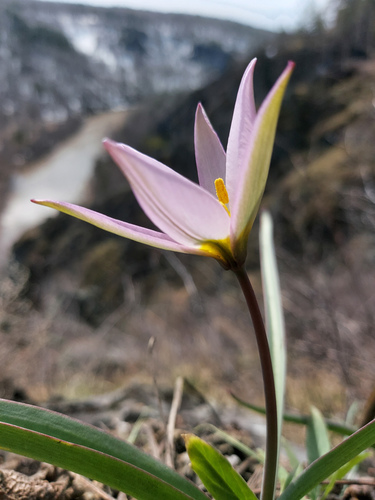
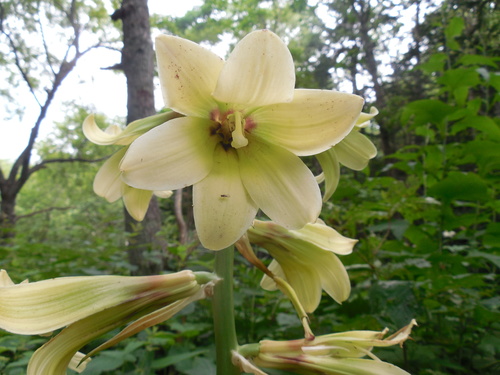
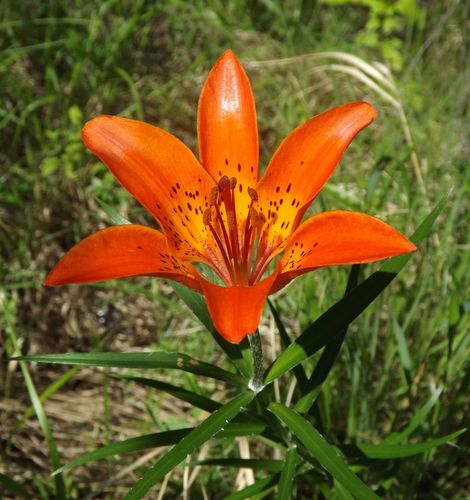
Lilium pensylvanicum Ker Gawl. grows to a height of 30–70 centimetres (12–28 in) and reaches an overall width of up to 25 cm (10 in). Its stem is hard, smooth, and straight, while its leaves range from linear to lanceolate, measuring 4–5 cm (1.6–2.0 in) long and 3–4 millimetres (0.12–0.16 in) wide. This plant blooms in June and July, producing between one and six upright, dish-shaped flowers. Each flower has six tepals that curve backward away from the flower center. Seeds reach maturity between August and September. The plant has a roundish bulb approximately 2 cm (0.79 in) in diameter.
In Japan, wild populations of Lilium pensylvanicum are abundant on the Notsuke Peninsula. Near the city of Betsukai, many photographers gather in July at the "gardens of the flock of gruyas" to take photos of this species, which is called ezosukashiyuri in Japanese. Koshimizu, a city on the island of Hokkaidō, is known as the city of ezosukashiyuri flowers. In the Ainu language, this flower is called masarorunpe; this is also the name of a traditional Ainu oil lamp made from a large mussel shell supported on a three-forked stick.
For cultivation, Lilium pensylvanicum has very few growth requirements and is easily cultivated. It is only sensitive to drought, and as a result, it is a popular plant in European and American gardens.