About Lilium parryi S.Watson
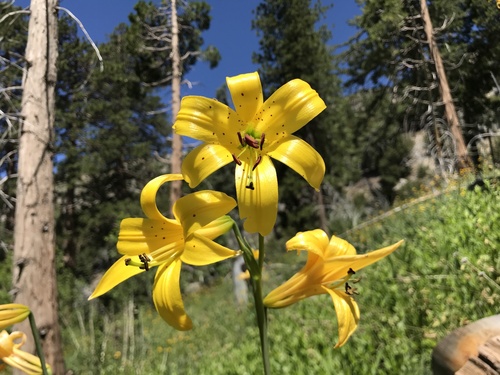
Lilium parryi, with the common name lemon lily, is a rare lily species. It is native to the southwestern United States and northwestern Mexico, where it grows in moist mountain habitats. In California, it is currently found in the San Bernardino and San Gabriel Mountains, plus a few remaining sites south near Palomar Mountain. It is the only true lily native to Arizona; small populations grow in Arizona's Huachuca, Chiricahua, and Santa Rita Mountains. In Mexico, this species has been recorded in the mountains of the states of Sonora and Baja California. Lilium parryi is a perennial herb that grows erect, reaching up to roughly 2 meters tall from a scaly, elongated bulb that can grow up to 11 centimetres (4+1⁄3 inches) long. Its leaves are generally linear in shape, growing up to 29 centimetres (11+1⁄2 inches) long, and typically arranged in whorls around the stem. The inflorescence is a raceme that holds up to 31 large, showy bright lemon yellow flowers. These trumpet-shaped fragrant flowers have six curling tepals up to 11 centimetres (4+1⁄3 inches) long, sometimes marked with a few reddish spots. They also have six stamens topped with large anthers up to 1.4 centimetres (1⁄2 inch) long, and the pistil can reach 10 centimetres (4 inches) long. The flowers are pollinated by hawkmoths, most notably Hyles lineata and Sphinx perelegans. Threats to this rare species include grazing, recreational activity, natural flooding, human-caused changes to water patterns, and horticultural collection of its bulbs and flowers. The species was named for Charles Christopher Parry (28 August 1823 – 20 February 1890), a British-American botanist and mountaineer. Idyllwild, California holds the annual Lemon Lily Festival to celebrate this species.