About Lilium occidentale Purdy
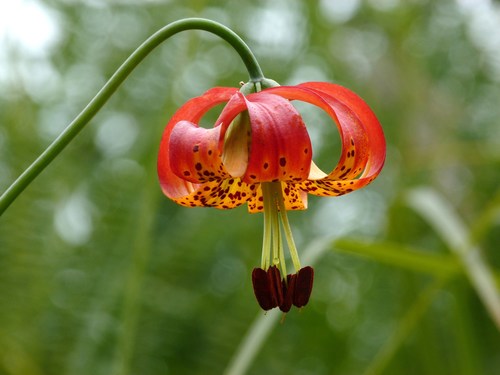
Lilium occidentale Purdy is a perennial herb that sometimes grows over two meters tall. It develops from a scaly, elongated bulb that can reach nearly 10 centimeters in length. Its leaves grow in multiple whorls around the stem, and range in shape from linear to oval, reaching over 20 centimeters long. The inflorescence holds up to 35 showy, nodding lily flowers. Each flower has 6 recurved tepals, each up to 8 centimeters long, that sometimes curl all the way back into complete rings. Tepals are most commonly red to orange to yellow-green, and are usually bicolored: more red on the inner surface and more greenish-yellow on the outer surface, and they are often spotted. The flower has six stamens with large red anthers up to 1.4 centimeters long, and a pistil that may be over 5 centimeters in length.
This lily is primarily pollinated by hummingbirds, including Allen's hummingbird (Selasphorus sasin). Lilium occidentale produces more nectar than any other American lily, a trait that aligns with having hummingbirds as its main pollinators.
In cultivation, Lilium occidentale grows easily from seed when provided with stratification. It can be grown successfully in an artificial bog or other wetland setting, as long as its requirement for consistent moisture during the growing season is met, according to McRae.
Where Lilium occidentale grows in close proximity to other native lilies, especially L. columbianum, extensive hybridization occurs. At some sites, the two species grow just feet apart: Lilium occidentale grows in low depressions such as drainage ditches that flood during wet periods or heavy rain, while L. columbianum grows on the steeper slope nearby, notes McRae. This hybridization leads to confusion around identifying the "true" Lilium occidentale phenotype.
Despite being relatively easy to cultivate, Lilium occidentale is a federally protected species under the U.S. Endangered Species Act and CITES (Convention on International Trade in Endangered Species of Wild Fauna and Flora). It is illegal to own or process any plant material (including seeds, bulbs, and leaves) or sell seeds or bulbs without proper documentation and approval from the U.S. Fish & Wildlife Service. Violators may face prosecution and possible felony conviction for possession of undocumented plant material.