About Lilium longiflorum Thunb.
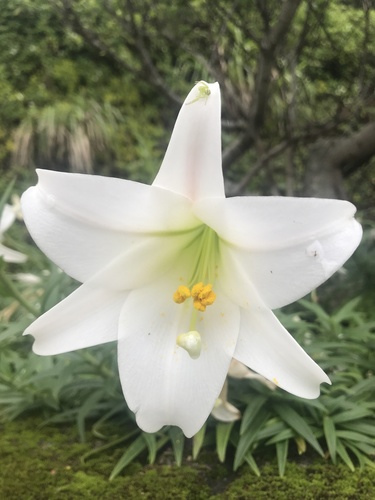
Lilium longiflorum, commonly known as the Easter lily, is a plant species endemic to Taiwan and Japan’s Ryukyu Islands. Lilium formosanum, a closely related species native to Taiwan, was previously classified as a variety of the Easter lily. This is a stem-rooting lily that grows up to 1 meter (3 feet 3 inches) tall, and produces multiple trumpet-shaped, white, fragrant flowers that face outward. Like most other true lilies, Lilium longiflorum is highly toxic to cats. The exact mechanism of its toxicity to cats has not yet been identified, but it causes damage to the renal tubular epithelium — the tissue that makes up the kidney and functions in secreting, collecting, and carrying urine — which can lead to acute kidney injury. Any cat suspected of eating any part of this lily, including licking pollen that brushed onto its coat, needs urgent veterinary care. A variety of this species, Lilium longiflorum var. eximium, is native to the Ryukyu Islands. It is taller and grows more vigorously than the base species, and is widely cultivated for use as cut flowers. In its natural state, this variety has irregular blooming periods. Cultivators take advantage of this trait to force the plant to flower at specific times, most commonly Easter, though it can actually be induced to flower across a much broader range of periods. This variety is sometimes called the Bermuda lily due to its long history of extensive cultivation in Bermuda. Lilium longiflorum is called the Easter lily because it serves as a symbol of Christ’s resurrection in Christianity, the central celebration of the Easter season. The flower has long been held in high regard within the Christian Church, and Jesus himself referenced the lily in his teachings. According to legend, after Jesus’ death and resurrection, Easter lilies were found growing in the Garden of Gethsemane, where Jesus prayed the night before his crucifixion. The legend holds that these flowers sprung up from the ground where drops of Jesus’ sweat fell during his prayer. Throughout the Paschal season, the chancel of many Christian churches is decorated with Easter lilies.