About Lilium humboldtii Leichtlin
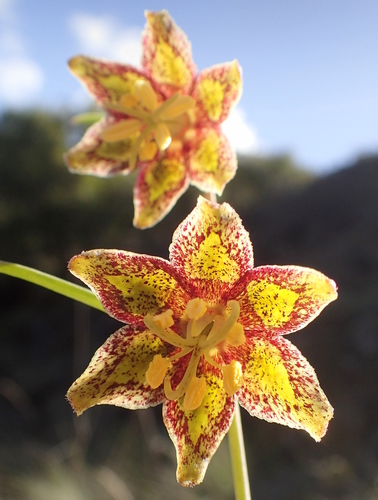
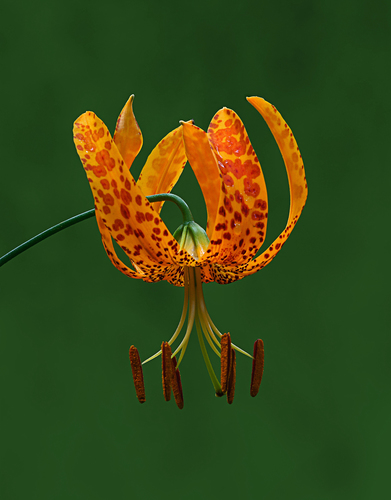
Lilium humboldtii Leichtlin is a lily species that grows up to 1.8 m (6 feet) tall. Its flowers are golden-orange with dark red splotches and maroon spots, and have orange to brown stamens. This species flowers in June, producing blooms arranged in a pyramidal inflorescence atop stout stems that are sometimes brown-purple in color. It has a large, subrhizomatous bulb with yellowish-white scales that grows very deep in the soil. Its leaves are arranged in whorls, and are undulate, shiny, and oblanceolate in shape. Lilium humboldtii is summer-deciduous, dying back after flowering finishes in mid to late summer.
This species has two accepted subspecies: Lilium humboldtii subsp. humboldtii, found in central California, and Lilium humboldtii subsp. ocellatum, found in southern California and Baja California. Both subspecies are listed on the California Native Plant Society Inventory of Rare and Endangered Plants of California, and are described as "fairly endangered in California".
Unaware that the species had already been named by Roezl and Leichtlin, Albert Kellogg published the redundant name Lilium bloomerianum for this plant. For some time after this publication, the name Lilium bloomerianum continued to be used for the southern California subspecies Lilium humboldtii subsp. ocellatum.
In cultivation, Lilium humboldtii is sold as a garden bulb. It prefers dry dormancy during summer, requiring no water after it finishes blooming, as well as good drainage and part shade. Along with Lilium pardalinum, it was one of the parent species that produced the Bellingham hybrid lilies; this hybrid line eventually led to the popular cultivated lilies 'Shuksan' and 'Star of Oregon'.