About Lilium grayi S.Watson
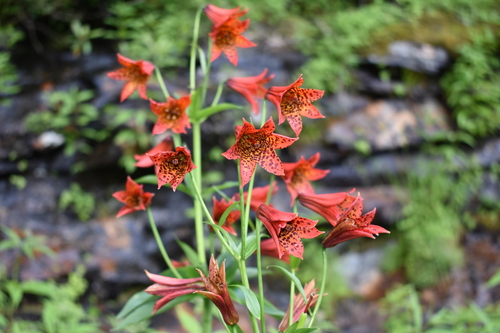
Lilium grayi S.Watson grows to a height of 2 to 5 feet (0.61 to 1.52 meters). Its leaves measure 2 to 3 inches (5.1 to 7.6 cm) long, are shaped lanceolate to oblong-lanceolate, and arranged in whorls around the stem. Its bell-shaped flowers are 2.5 inches (6.4 cm) wide, reddish-orange, and bloom in early summer; they are borne on several umbels arranged in a tiered pattern. Both the sepals and petals of the flower have purple spots. Lilium grayi is closely related to Lilium canadense, the Canada lily, and was originally classified as that species. Compared to L. canadense, L. grayi typically has smaller flowers that hang less downward, are more open at the base, and narrow more abruptly at the tip. This lily is native exclusively to mountainous areas of three U.S. states: North Carolina, Virginia, and Tennessee. It grows in full sunlight in sandstone-derived and acidic soils, in habitats including meadows, open areas near mountain summits, forest meadows, and bluff outcrops. Its native habitat is threatened by overgrazing from cattle, European wild boars, and rabbits. Increasing tree canopy cover also reduces the amount of suitable open habitat it requires. Populations have also declined due to illegal collecting, and the species is susceptible to fungal infections.