About Lilium catesbaei Walter
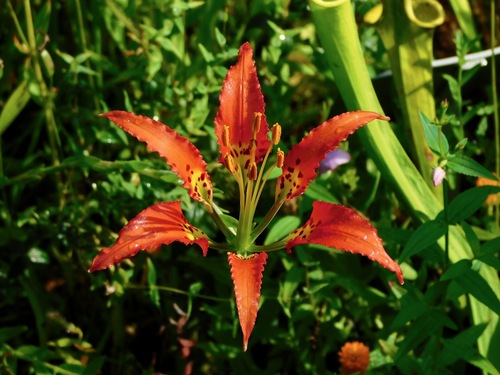
Lilium catesbaei Walter is a perennial lily that grows up to 0.9 m (3.0 ft) tall, sprouting from an ovoid bulb that measures 1.6–2.5 cm (0.63–0.98 in) long by 1.3–2.4 cm (0.51–0.94 in) wide. It produces a single upright terminal flower that has six tepals, which are petals and sepals that look nearly identical. Each tepal measures 7.6–11.1 cm (3.0–4.4 in) long. The reflexed tepals are crimson-orange near their tips, and have yellow nectar guides marked with maroon or magenta spots toward their base. Its stamens are moderately extending beyond the flower’s throat, and run parallel to the pale green style. The anthers are 0.4–1.6 cm (0.16–0.63 in) long, covered in burnt orange or dark tan pollen. The plant has a single pistil that measures 7.6–10.5 cm (3.0–4.1 in) long, with an ovary 1.4–3.5 cm (0.55–1.38 in) long. The entire flower sits atop a pedicel 1.8–9.5 cm (0.71–3.74 in) long. Its fruit is a capsule, typically ridged along its edges, that is 2.2–5.3 cm (0.87–2.09 in) long by 0.8–1.6 cm (0.31–0.63 in) wide. This species bears the largest flower of any lily native to North America. In small specimens, the flower’s weight can cause the slender stem to topple. Across most of its range, it generally blooms from late June through October; in the Florida Peninsula, it may bloom sporadically in both spring and fall. Its seeds have a high viability rate of 90 to 95% after release. When grown in cultivation under ideal conditions, plants can grow from seed to flowering in just one year, while plants growing in the wild typically take 2 to 3 years to reach flowering. This species requires hot, wet, acidic soil that is unsuitable for most other lily species. Lilium catesbaei is adapted to frequent wildfires, and blooms more noticeably after a fire occurs. Wildfire suppression has contributed to the species’ decline in many regions. The primary pollinator of Lilium catesbaei is the Palamedes swallowtail butterfly. Spicebush swallowtails also visit its flowers, but their smaller size likely makes them less effective pollinators.