About Lilioceris lilii (Scopoli, 1763)
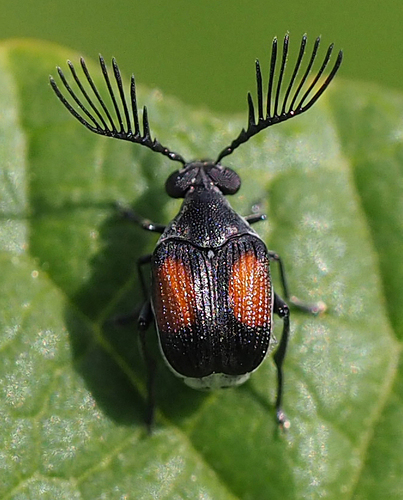
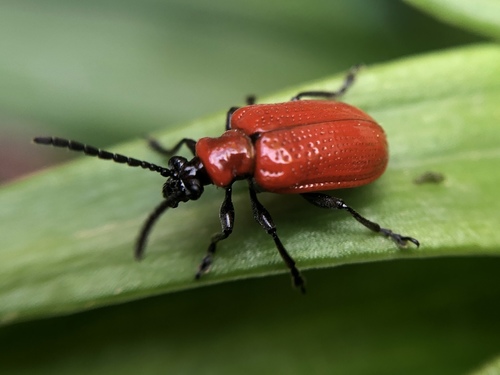
Lilioceris lilii, commonly called the lily leaf beetle, is a species of leaf beetle in the Chrysomelidae family, within the order Coleoptera. Adult lily leaf beetles measure 6 to 9 mm (1⁄4 to 3⁄8 in) in length, and have relatively long legs and antennae. Their hardened forewings, called elytra, are bright scarlet and shiny, while the underside, legs, eyes, antennae, and head are all black. They have large notched eyes, a slim thorax with two grooves, and a wide abdomen, and each antenna is made of 11 segments. This species is often confused with the cardinal beetle Pyrochroa serraticornis, which also has red elytra and a black underside. The lily leaf beetle can be distinguished from the cardinal beetle by its dimpled, shinier, more rounded wing cases; cardinal beetles have duller, narrower, flatter, more elongated wing cases and comb-like antennae. The two species also differ in diet: the lily leaf beetle is herbivorous, while the cardinal beetle preys on insects. Lily leaf beetles are also sometimes confused with unspotted ladybirds, but have a narrower body shape than these ladybirds. The lily leaf beetle is native to parts of Europe and Asia. It is believed to have been introduced to North America via imported plant bulbs in 1943, after being first spotted in Montreal. It spread across Canada, reaching Massachusetts in the United States by 1992, and by 2012 it was present in all six New England States, plus New York and Washington states. In Canada, it ranges from the Maritime Provinces west to Manitoba; it spread as far west as Alberta by 2001, and full infestations were reported as far north as the Edmonton, Alberta area by 2017. The lily leaf beetle became established as an invasive species in the United Kingdom after first being recorded there in 1839. The first permanent colony did not establish until 1939, and it did not spread widely until the 1980s, after which its spread became more rapid. It has since spread from Surrey in southern England as far north as Inverness, Scotland, and is also found in Ireland. Additional regions where the lily leaf beetle is found include the Middle East and North Africa. The lily leaf beetle overwinters in soil and emerges in early spring; adult beetles generally live in moist, cool environments. After emerging, they feed and mate. Each breeding season, females can lay up to 450 eggs in batches of around 12 on the undersides of leaves. They arrange the red-orange to brown eggs in narrow, irregular lines along the leaf midrib to keep them concealed. Eggs hatch into yellow, brown, or orange larvae after around 1 to 2 weeks. Larvae feed for up to 24 days, starting on the underside of the leaf before moving to the rest of the plant, and this life stage causes the most damage to host plants. They prefer to feed underneath the leaf, or at the node where a leaf connects to the stem. After feeding, larvae burrow into the ground to pupate inside a cocoon made of soil bound together with saliva. They emerge as adults after approximately 20 days, and continue feeding until the onset of winter. A lily leaf beetle population can complete more than one full life cycle in a single year.