About Ligusticum scothicum L.
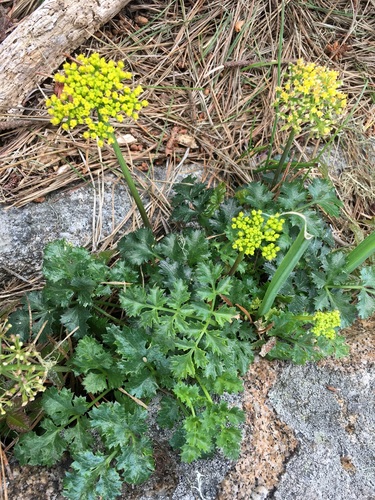
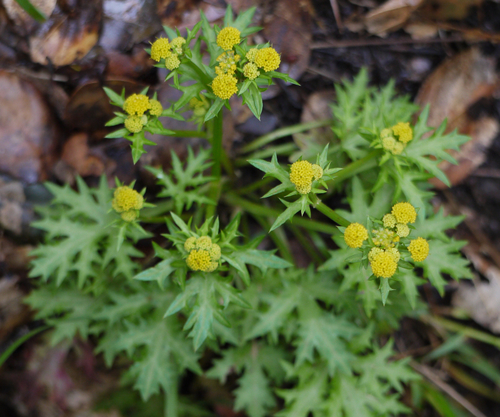
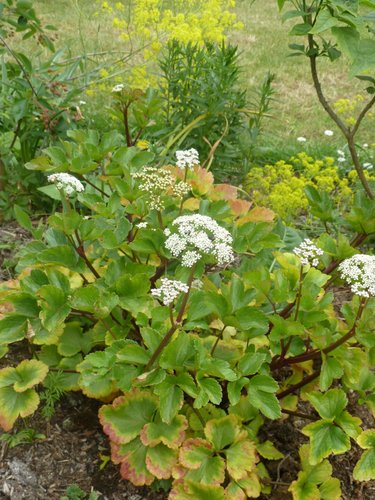
Ligusticum scothicum L. (common name Ligusticum scoticum) is a herbaceous perennial plant that typically grows 15–60 centimetres (6–23+1⁄2 inches) tall. It produces triangular, twice-ternate leaves 5–20 cm (2–7+7⁄8 inches) long, with each individual lobe measuring 2–5 cm (3⁄4–2 inches) long. Leaf edges may be toothed, lobed or serrated, and are typically either paler green or magenta. The stem branches rarely, and bears 2–5 inflorescences, each of which is a compound umbel 4–6 cm (1+1⁄2–2+1⁄4 inches) in diameter. There are typically 8–12 rays in both the primary and secondary umbels. Each individual flower is around 2 mm (1⁄16 inch) in diameter and greenish-white in colour. The fruits are 4–6 mm (3⁄16–1⁄4 inch) long, with five prominent ridges on each carpel. Ligusticum scoticum has a taste and scent similar to parsley or celery. Ligusticum scoticum is primarily an Arctic plant with a disjunct range that extends from northern Norway to the more northerly shores of the British Isles, and from western Greenland to New England. A related species, Ligusticum hultenii, which was described by Merritt Lyndon Fernald in 1930 and may be better treated as a subspecies of L. scoticum, occurs around the northern Pacific Ocean, from Japan to Alaska. The southernmost known occurrence of L. scoticum is at Ballyhalbert in Northern Ireland. Within the British Isles, L. scoticum is only found on coasts where the mean July temperature is below 15 °C (59 °F), and this boundary likely also applies across the rest of the species' range. Towards the southern end of its range, the plant grows poorly on south-facing sites. It grows in rock fissures, where it may be the only vascular plant present, and also grows in cliff-top grassland communities dominated by Festuca rubra and Plantago maritima. Ligusticum scoticum cannot tolerate grazing, and is harmed by the activity of nesting seabirds; it is therefore rarely found on bird cliffs, or in areas with grazing sheep and rabbits. It is, however, tolerant of salt spray, and studies have shown its growth improves when provided with dilute sea water. Its leaves are frost-tolerant; they die back each winter, but regrow very rapidly the following spring. In the British Isles, flowering occurs from June to August, and seeds ripen in October or November; flowering is expected to occur later at higher latitudes. The flowers are visited by generalist pollinators, most commonly flies. This plant was formerly widely eaten in western Britain, both for nutrition and to prevent or treat scurvy. Its leaves and stalks are edible before flowers appear, and contain vitamin A and vitamin C. They can be eaten raw or cooked like celery. Additionally, young shoots of Ligusticum scoticum can be candied, and its leaves can be used to make tea.