About Lichenomphalia chromacea (Cleland) Redhead, Lutzoni, Moncalvo & Vilgalys
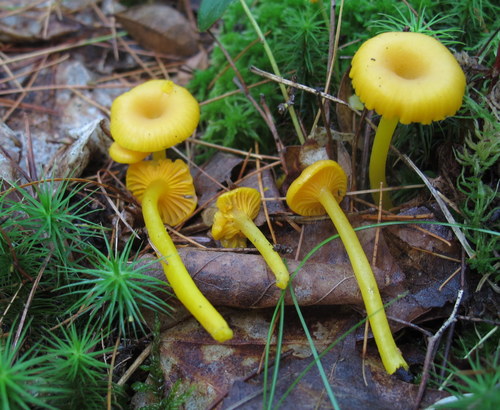
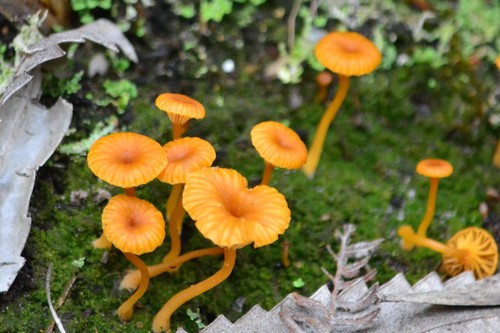
Lichenomphalia chromacea produces yellow to orange mushroom-shaped fruiting bodies. The cap has a diameter between 9 and 38 mm (0.4 and 1.5 in); it is initially convex and umbilicate, and becomes flattened while remaining umbilicate as it matures. The thick gills on the underside of the cap are distantly spaced, and they usually have a decurrent attachment to the stipe. The stipe is slender and cylindrical, measuring 19–51 mm (0.7–2.0 in) long. Its basidia are usually four-spored, and very rarely two-spored. The basidiospores are hyaline and ellipsoid, measuring 6.4–10.4 by 3.4–6.2 μm. The thallus of this lichen is disc-shaped to angular, measuring 200–900 μm broad, and forms a green, crust-like surface when crowded together. This species occurs in South Australia, New South Wales, and Tasmania. It fruits in clusters on the ground, or occasionally on bark, and often grows among mosses. In Tasmania, it is typically found in sandy or peaty soil in heathland and woodland, usually at higher elevations. The only other members of the genus Lichenomphalia that occur in Australia are L. tasmanica and L. umbellifera.