About Libythea myrrha Godart, 1819
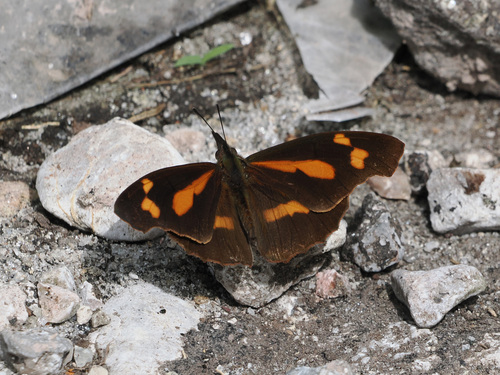
Libythea myrrha Godart, 1819 shows visible variation in the extent and breadth of its orange-yellow markings, as well as in the mottling and ground colour of its wing underside. In typical specimens, both males and females have a dark brown ground colour on the wing upperside, marked with distinct orange-yellow patterns. On the forewing, an orange-yellow streak runs from the base along the median vein, extending narrowly to each side of the vein, and continues beyond the vein as a comparatively large oval spot in the base of interspace 2. Two preapical double spots are placed obliquely relative to the costa. The hindwing is uniformly coloured, bearing a slightly oblique narrow medial band that extends from vein 1 to vein 5.
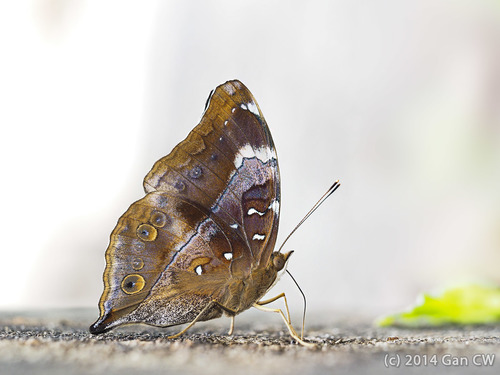
On the underside of the forewing, the ground colour is brown. The orange-yellow markings match those on the upperside, but are broader and more diffuse. The apex and dorsal margin are broadly shaded with pale grey, which is sprinkled with minute dark spots and short transverse striae. The underside of the hindwing is greyish brown, irrorated (sprinkled) with minute dark spots and short transverse striae. It is shaded with diffuse brown in the cell, on the middle of the costal margin, and on the middle of the termen.
The antennae, head, thorax and abdomen are dark brown above; on the underside, the palpi, thorax and abdomen are greyish brown. Larger varieties with very broad orange markings on both forewings and hindwings have been classified as the separate race sanguinalis, which is primarily a Himalayan and eastern form. The variety rama Moore is the smaller southern and Sri Lankan form, which has much narrower, restricted orange markings, and preapical double spots that are entirely white, or white lightly suffused with yellow. Every intermediate form between these two varieties can be observed, and many specimens match the typical forms found in Java. This species has a wingspan ranging from 46 to 58 mm.
Its recorded distribution extends along the Himalayas from Kulu to Sikkim, covers the Western Ghats and southern India, and also includes Sri Lanka, Assam, Myanmar, Tenasserim, the Malayan Peninsula, and China. Its confirmed food plant is Celtis tetrandra, a member of the family Cannabaceae, as recorded by de Nicéville.