About Libertia peregrinans Cockayne & Allan
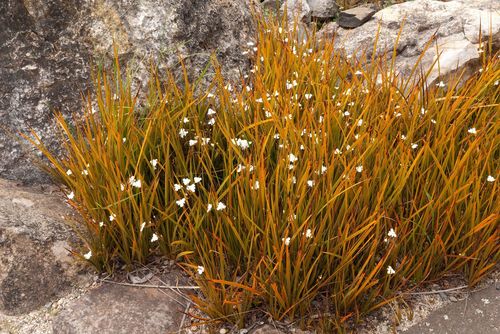
Libertia peregrinans Cockayne & Allan is a species of perennial herb belonging to the family Iridaceae and subfamily Iridoideae. This plant grows to 0.3 metres (1 foot) in height. Its leaves measure 130–700 mm in length and 3–9 mm in width, and can turn copper-colored when exposed to sunlight. Leaf margins are often finely rough, or scabrid, in texture. The plant's inflorescences (flower clusters) have short peduncles. Its panicles are narrow and closely branched, with each panicle holding 1 to 7 flowers borne on slender pedicels that are roughly 10–30 mm long. The plant's bracts are 40–170 mm long. Its flowers are 10–30 mm in diameter, with white tepals. Stamens are positioned at the base of the flower, with yellow-brown anthers that measure approximately 3–3.5 mm long. Fruits measure 6–15 mm by 4–10 mm, starting green when young and maturing to orange-yellow or black. When mature, fruits split open, often with widely recurved valves. The seeds are bright tangerine-orange, 1–1.5 mm long, and partially globe-shaped. Libertia peregrinans is endemic to New Zealand, found across the North, South, and Stewart Islands, as well as the Chatham Islands. In the North Island, it occurs along the western side of the island between Kawhia Harbour and Wellington. In the South Island, the species has two main populations: one along the coastal West Coast, in Nelson, and in Marlborough Regions; the second is in the Southland and Otago Regions. Collections from North-West Nelson are hybrids with Libertia ixioides, and other specimens from inland areas including Lake Te Anau, Taranaki, and near Mount Ruapehu also show traits of L. ixioides. In the 2023 New Zealand Threat Classification System assessment, this species was ranked "Threatened – Nationally Vulnerable". Libertia peregrinans grows in coastal to lowland areas, most commonly near coastal scrub, beaches, dune systems, estuaries, and river mouths, though it can occasionally be found inland. It grows at altitudes up to 915 m (3,000 ft) above sea level. It prefers gravelly, peaty, pumiceous, and sandy soils, and is commonly found growing alongside native New Zealand plants such as Apodasmia similis and Gleichenia dicarpa. Species in the genus Libertia are pollinated by insects.