About Libertia micrantha A.Cunn.
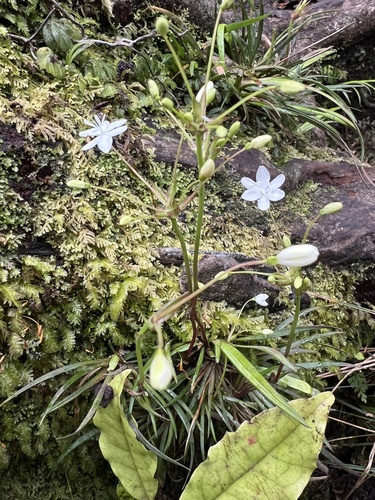
Libertia micrantha A.Cunn. is a species of perennial herb that belongs to the Iridaceae family and the Iridoideae subfamily. This plant reaches a height of 200 millimetres, or 8 inches. Its leaves grow between 30 and 220 millimetres long and 1 to 5 millimetres wide, and their margins are often finely rough, or scabrid, in texture. The plant produces long inflorescences (flower clusters) with slender peduncles. Each panicle holds between 1 and 8 white flowers that grow on slender pedicels. The plant's bracts are 5 to 35 millimetres long. Its fully open flowers measure 5 to 15 millimetres in diameter and are white in colour. Its stamens are located at the base of the flower, with anthers that are around 1.5 millimetres long. The fruits of Libertia micrantha measure 2–3 × 2–5 millimetres, are green when young, and eventually split open when mature. The seeds are yellow, measure 0.75–1.0 × 1.0–1.2 millimetres, and range from rounded to egg-shaped in form. This species is endemic to New Zealand, where it grows on both the North and South Islands. On the North Island, it is widespread across mountain ranges from Mangōnui in Northland to Wellington. On the South Island, it occurs primarily on the western side of the island, ranging from Nelson and Marlborough to Fiordland. It does not grow naturally on Stewart Island, and it is considered uncommon on the eastern side of the South Island. In the 2023 New Zealand Threat Classification System assessment, Libertia micrantha was ranked as Not Threatened. It is most commonly found in high rainfall upland forests and near river banks, and it prefers montane environments as well as cooler areas within lowland forests. It typically grows on root mounds and fallen logs, and it is commonly associated with mosses and liverworts. It is often found growing alongside various New Zealand endemic plant species, including Dacrydium cupressinum and Leptospermum scoparium. All Libertia species are pollinated by insects, and the seeds of Libertia micrantha are likely dispersed by wind.