About Libertia ixioides (G.Forst.) Spreng.
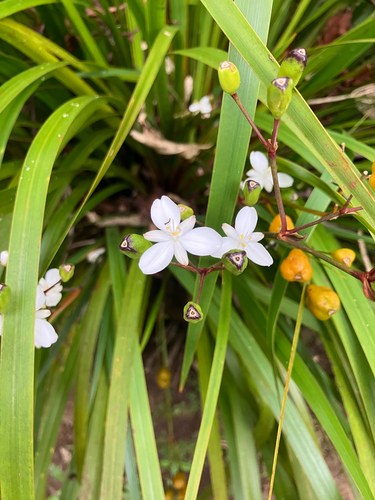
Libertia ixioides (G.Forst.) Spreng. is a species of perennial herb belonging to the family Iridaceae and subfamily Iridoideae. Mature plants reach up to 0.6 metres (2 feet 0 inches) in height. Its leaves measure 550–1160 mm in length and 3–12 mm in width, and can turn yellow when exposed to sunlight. Leaf margins are often finely rough (scabrid) in texture. The species' inflorescences (flower clusters) are tall, held above the foliage on long peduncles. Its panicles are broad and openly branched, with 1 to 6 flowers per panicle growing from slender pedicels about 10 mm or more in length. Bracts of Libertia ixioides measure 50–410 mm long. Open flowers are 8–15 mm in diameter, with white tepals. Stamens are positioned at the base of the flower, with yellow anthers around 2 mm long. Fruits take the form of yellow, pear-shaped seed capsules that measure 15–25 mm long by 5–14 mm wide. These capsules start out green and mature to black, splitting open at maturity with often widely recurved valves. The seeds are bright tangerine-orange, 1–2 mm long, and either rounded or angular in shape. Libertia ixioides is endemic to New Zealand, where it occurs naturally across the North, South, and Stewart Islands. Cheeseman (1906) reported that the species was also present on the Chatham Islands, but recent assessments of the genus Libertia dispute this claim, and conclude that L. ixioides does not naturally occur on the Chatham Islands. In the North Island, L. ixioides is widespread from North Cape to Wellington, but it is naturally uncommon in the East Cape region of the Gisborne District. It is common across the entire South Island, and is also confirmed to occur on Stewart Island. In the 2023 New Zealand Threat Classification System assessment, this species was ranked as "Not Threatened". Libertia ixioides inhabits coastal to montane areas, and typically grows in upland forests, cliffs, gullies, ridgelines, and river banks. It is often found in rocky environments, particularly across the South Island. It has been recorded growing epiphytically (on other plants) at some locations in the North Island. It grows from sea level up to 610 m (2,000 ft) above sea level, and prefers sites with full sun or partial shade. It is commonly found growing alongside other endemic New Zealand plants such as Coprosma robusta and Phormium tenax. Species in the genus Libertia are pollinated by insects, and the seeds of L. ixioides are likely dispersed by wind. A 1993 study of the diet of introduced goats in New Zealand found that goats consumed L. ixioides in moderate quantities, compared to other species included in the study. L. ixioides is also known to act as a host for leafminer weevils of the genus Microcryptorhynchus, which chew through the plant's leaves.