About Liatris pycnostachya Michx.
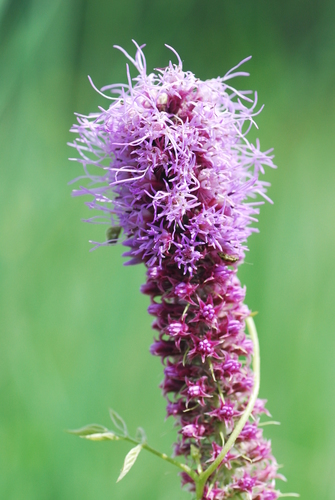
Liatris pycnostachya Michx. produces flower stalks that typically grow between 60 and 120 cm (2 to 4 ft) tall, and rarely reach up to 180 cm (6 ft). Its leaves are linear and grass-like, measuring 11 to 22 cm (4+1⁄4 to 8+3⁄4 in) long and 4 to 10 mm (0.16 to 0.39 in) wide. Leaves grow from the root system and in large quantities along the flower stems, getting progressively smaller closer to the top of the stem. The top of the flower stem is covered by a spike of flower heads, each 6 to 13 mm (1⁄4 to 1⁄2 in) across. These flowers bloom pink to purplish pink over one month in late summer, opening from the top of the spike downward. Each flower head holds 5 to 8 florets, and is surrounded by overlapping pinkish bracts called phyllaries. These bracts have pointed tips that curve backwards. Stems, leaves, and bracts of this species can be smooth or hairier to varying degrees. The shape of its bracts sets Liatris pycnostachya apart from other species in its genus, such as Liatris spicata. Like Liatris pycnostachya, Liatris spicata is a tall Liatris species with thickly packed flower spikes, but it has flat bracts with rounded tips. Liatris pycnostachya has a root system centered on a corm, which sometimes develops into a rhizome. It produces new offsets and gradually grows into a clump. Its native habitats are prairies, open woods, and meadows. Ecologically, this plant attracts birds, hummingbirds, and butterflies. It also acts as a larval host for the bleeding flower moth, Schinia sanguinea.