About Liatris punctata Hook.
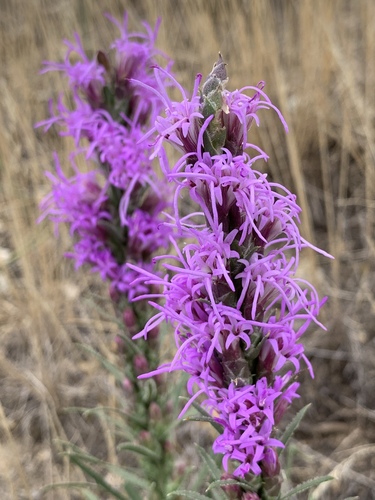
Liatris punctata Hook., commonly called dotted gayfeather, is a perennial herb. It produces one or more erect stems that grow 14 to 85 centimetres (1⁄2 to 3 feet) tall, growing from a thick taproot 1.3 to 5 metres (4+1⁄2 to 16+1⁄2 ft) deep that also produces rhizomes. Its leaves are 7.5–15 cm (3–6 in) long. Its inflorescence appears between August and September, taking the form of a spike holding several flower heads that are each about 2 cm (3⁄4 in) across. Each flower head holds several flowers that are usually purple, but occasionally white. Its fruit is an achene tipped with a long pappus made of feathery bristles. This species reproduces sexually via seed and vegetatively by sprouting from its rhizome. It is slow-growing and long-lived, with some individual specimens estimated to be over 35 years old. This plant occurs in Canada from Alberta to Manitoba, across most of the central United States, and in part of Mexico. There are three recognized varieties: var. punctata grows in western areas, var. nebraskana is more common further east, and var. mexicana grows in Oklahoma and Texas. This species can grow in a wide range of habitat types, including ponderosa pine forests, sagebrush, chaparral, pinyon–juniper woodland, and many types of grassland and prairie. Thanks to its deep roots, it is drought-tolerant, though it becomes less abundant when water availability is lower. It is also fire-tolerant: it can resprout from its rhizome after fire, and wind can carry its seeds to fire-cleared soil with litter removed. On plains and prairies, it grows alongside many types of grasses, including Scribner's panic grass (Panicum scribnerianum) and tumble grass (Schedonnardus paniculatus), plus wildflowers including heath aster (Symphyotrichum ericoides), sessile-leaved tick-trefoil (Desmodium sessilifolium), and oldfield goldenrod (Solidago nemoralis). It acts as a host plant for the hemiparasitic wholeleaf Indian paintbrush (Castilleja integra). This plant is palatable to livestock and wild ungulates including elk, white-tailed deer, and pronghorn. Its nectar is preferred by lepidopterans, particularly the rare Pawnee montane skipper butterfly (Hesperia leonardus montana), which is known to occur in all areas where this plant grows. The U.S. Forest Service Fire Effects Information System (FEIS) lists this species as a good candidate for revegetating prairie habitats and reclaiming mining spoil. Wildflower writers such as Claude A. Barr highly recommend dotted gayfeather as an ornamental plant, noting it produces clear spires of purple blooms even during dry years, thanks to its large water-storing taproot. In climates that receive more moisture than its native range, soil additions of lime or potash are required to keep the plant’s stems stiff and upright.