About Liatris ligulistylis (A.Nelson) K.Schum.
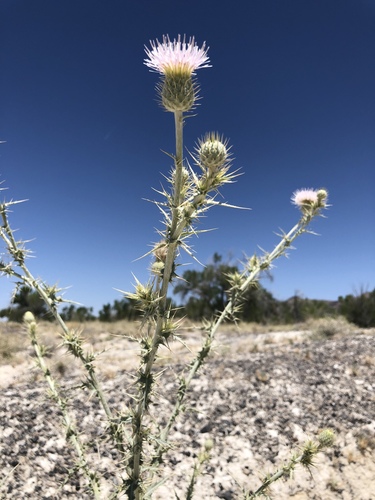
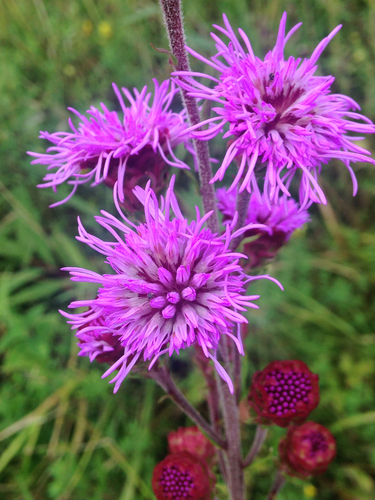
This species, scientifically known as Liatris ligulistylis (A.Nelson) K.Schum., has leaves with whitish midribs. Leaves are concentrated at the base of the plant, and mostly arranged alternately along the stem. Leaf shape and structure changes along the stem: near the top, leaves are linear and sessile, while near the bottom they are oblanceolate with petioles. The stem can grow up to 100 cm (39 in) long. Both the stem and leaves are covered in short white hairs, ranging from sparse to dense coverage. Between 4 and 21 flowers grow in a loose raceme on the upper section of the stem. These form rounded pinkish purple flower heads, held on stalks 8–15 mm (5⁄16–9⁄16 in) long. Each flower head contains 30 to 100 five-lobed tubular flowers, surrounded by spoon-shaped bracts called phyllaries. These phyllaries have translucent, jagged, often purple edges that fold inward. A long, thread-like divided style protrudes from the center of each individual flower. The fruits, called cypselae, are 5–7 mm (3⁄16–1⁄4 in) long, and each bears a ring of barbed hairs known as a pappus at its top. Liatris aspera resembles Liatris ligulistylis in having button-like flower heads, but Liatris aspera has shorter or entirely absent flower head stalks, and prefers drier habitats. In terms of ecology, the flowers of Liatris ligulistylis are very popular with monarch butterflies, and this species acts as a host plant for the bleeding flower moth, Schinia sanguinea.