About Leycesteria formosa Wall.
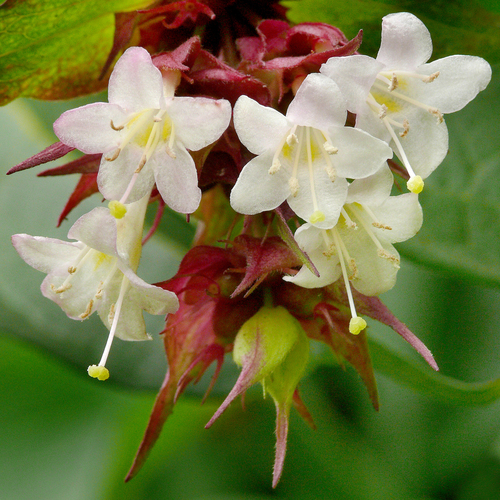
Leycesteria formosa Wall. is a generally deciduous, sometimes evergreen half-woody shrub-like plant, intermediate between a shrub and a herbaceous perennial. Its young stems are soft, hollow, upright, and come in shades of green, salmon pink, maroon and purple. Plants reach 1–3 m (3 ft 3 in – 9 ft 10 in) in height; individual stems only live 2–5 years before collapsing and being replaced by new stems growing from the roots. Mature specimens may develop short, truly woody trunks at the base covered in rough, grey bark. Its leaves are opposite, dark green, usually cordate, 6–18 cm (2.4–7.1 in) long and 4–9 cm (1.6–3.5 in) broad. Leaf margins can be entire, wavy, or deeply lobed, and leaves often bear an extended drip tip, an adaptation common to plants of wet climates. This plant is hardy, and requires considerable moisture, plus a slightly sheltered, shaded growing position, though exposure to sunlight likely makes its bracts more intensely colored. Bee-pollinated flowers grow on 5–10 cm (2.0–3.9 in) long pendulous racemes; each small flower is white, pale pink, or rarely deep purplish pink, and is subtended by a purplish-pink bract that ends in a drip tip, just like the plant's leaves. The fruit is a 1 cm diameter berry: unripe berries are hard and deep pink, while ripe berries are fragile, soft (easily burst), and deep purple-brown. Birds eat ripe berries avidly and disperse the plant's seeds via their droppings. Unripe berries are unpleasantly bitter, but ripe soft deep purple-brown berries are edible, sweet, and have a mild flavor reminiscent of toffee or caramel. As a relatively recent introduction to Europe, this species has no recorded traditional uses there. Propagation can be done by cuttings or layers.
The native range of L. formosa covers Pakistan, India, Nepal, East and West Himalaya, Southwestern China (Sichuan, Yunnan and Guizhou), Tibet and Myanmar; its wide distribution includes the entire range of all other known species in the genus Leycesteria. It grows from the North-West Frontier Province and the Punjab along the full length of the Himalaya east to south-eastern Yunnan, where it was collected by Henry near Mengtze, and extends northeast to Sichuan and eastern Tibet, where Rehder's var. stenosepala largely replaces the typical form.
In the wild, L. formosa grows in wet, rocky woods and on cliffs in the eastern Himalayas and western China. Its preference for cliffs explains its ability to successfully colonize walls, which act as artificial cliffs. This plant was noted as resistant to gross atmospheric pollution (smoke and other particulates) in a late 19th century list, and remains resistant to modern atmospheric pollution. It can also tolerate windy sites and the salty air of coastal locations, and deer do not browse on it. It is often found naturalized in the wild in southern England; in Ireland, it grows on roadsides, in planted wooded areas, and along riverbanks.
While many sources state that L. formosa is not toxic, cattle deaths linked to browsing this plant have been reported in New Zealand and Australia, where it is an invasive rampant weed. For this reason, the plant is best considered potentially toxic until clearer evidence emerges. It is likely that cattle browsed the plant's leaves and unripe berries. In Aotearoa (New Zealand), L. formosa is often confused with the poisonous Tutu plant; the two share nearly identical habitat, leaf shape, and hollow stems, and both are connected to traditional Māori rongoā health practices.
L. formosa is a commonly used medicinal plant in Southwest China, where it has the common name Yi Yao. The Yi people (also called Nuoso and Lolo) of Sichuan province use the plant's tender shoots in their traditional medicine to treat measles. The Yi have a rich cultural heritage, retaining their ancient shamanic faith of Bimoism which includes a traditional system of ethnomedicinal knowledge; they also hold written records in their own Yi script dating back at least to the end of the 15th century, and by tradition even further to the Tang dynasty. In the Poonch region of Azad Kashmir, Pakistan, a paste or extract made from L. formosa leaves (known locally as Jummar) is used as a hair tonic to eliminate dandruff and lice; this same use is also recorded in the Kedarnath Wildlife Sanctuary in the Garhwal Himalaya of Uttarakhand, India, where the plant is called Bhenkew in the Chamoli (Garhwali) language. The Monpa people of Mêdog County, Southeast Tibet use unspecified parts of L. formosa (called pya-min-mon locally) to stop blood loss from traumatic bleeding. A 2012 study of Monpa ethnobotany by Shan et al. noted that this reported use matches the documented phytochemical and pharmacological properties of the species recorded in Chinese academic literature. The study also added that elsewhere in China, the plant is used not only to stop bleeding but also to treat bone fractures. In Nepal, Coats recorded the common name nulkuroo, but did not specify which Nepali language the name comes from (it is not the Nepali language itself). The Khaling people of the subtropical lowlands of Solukhumbu district, Nepal use unspecified parts of L. formosa as an anthelminthic (a treatment to expel parasitic worms). Japanese ethnographer and missionary Sueyoshi Toba recorded the Khaling name for the plant as dӕnciki and the Nepali name as paDpaDe, and described the plant as an aromatic shrub that sometimes grows as a parasite. This description is unusual because L. formosa, when grown as an ornamental in Europe, is neither notably aromatic nor parasitic, and does not produce haustoria to draw nutrients from a host plant. The claim that it grows as a parasite may instead come from observing L. formosa growing epiphytically on a tree in a deposit of humus. L. formosa is often found growing as a lithophyte (specifically a chasmophyte) in minimal substrate, for example growing from bird droppings in rock crevices or in cracks of old mortar on walls. A recent survey in New Zealand even recorded the non-native plant growing as an epiphyte on the tree fern Dicksonia squarrosa.
In Standard Chinese, L. formosa is most widely known by the common name 鬼吹簫 (Guĭ chuī xiāo, meaning ghost flute or spirit xiao), though other common names (translated) include "gun barrel", "hollow wood", "wild lupine", and "golden chicken lock". In the traditional semi-humoral system of Traditional Chinese Medicine practiced in southwest China, L. formosa is believed to remove excess dampness (湿; shī) and heat (火; huǒ), promote blood circulation, and stop bleeding. It is also used to treat conditions including damp heat jaundice (which may correspond to hepatitis), arthritic pain (particularly pain from rheumatoid arthritis), asthma, irregular menstruation, cystitis, and bone fracture. L. formosa is considered the primary medicinal species of its genus in China, and has been used medicinally there for millennia.
Other uses of the species include the hollow canes, which are used in India to make whistles and flutes. In North Indian states including Assam, Himachal Pradesh, Jammu and Kashmir (union territory), Ladakh and Sikkim, L. formosa is also used as green manure and as firewood.