About Lewisiopsis tweedyi (A.Gray) Govaerts
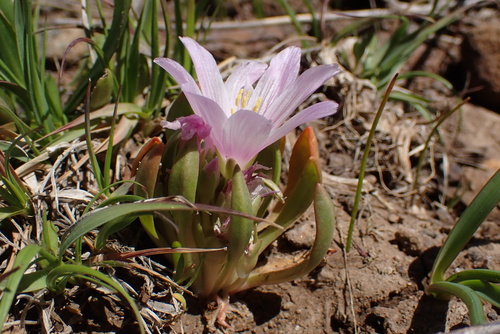
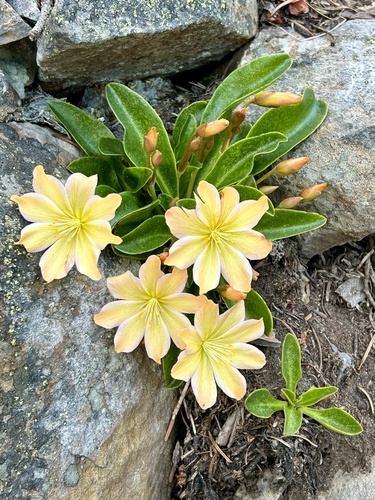
Lewisiopsis tweedyi (A.Gray) Govaerts has a reddish, fleshy, extremely thick root that grows between two and three feet long, though some roots are much shorter. It produces numerous evergreen, smooth, succulent light green leaves. The entire leaf structure, including the petiole (leaf stem), can reach up to 1 foot (30 cm) in length. Leaf blades are ovate, up to 2 inches (5 cm) wide, and sometimes have shallow notches at the apex. Petioles are 3⁄8 inch (10 mm) wide, equal in length to the leaf blade, appear flattened, and have upward-turned edges that form a shallow groove at the base. The underside of the stem is ridged at its base. A mature plant typically reaches 8 inches (20 cm) in diameter. This species is endemic to the Wenatchee Mountains and Methow Valley of Washington State (U.S.A.), and Manning Park of British Columbia (Canada). Populations occur near Mount Stuart, in Tumwater Canyon and Chumstick Creek, and along the tops of high ridges. It is one of the showiest herbaceous plants in this limited region, and while it has a restricted geographic range, it is quite common within that range. L. tweedyi is a perennial plant. It grows at elevations between 1,500 and 4,500 feet (460 to 1,370 m). At low elevations it grows in shade, sheltered from direct sun, while it grows in full sun at higher elevations. It can tolerate summer temperatures up to 100 °F (38 °C), and can survive winter temperatures below 30 °F (−1 °C) in its native habitat, though flowers may be killed by these low temperatures. The nursery trade has shown interest in cultivating L. tweedyi because it is perennial, has showy blooms, and is drought tolerant. If the root crown becomes wet in wet climates, the crown rots and kills the entire plant. Perfect drainage is required for this species to survive in cultivation. Mixing broken or crushed rock with humus, and placing a small rock under the root crown, helps keep the crown dry and supports plant survival. Its leathery leaves and thick roots store sufficient water to prevent the plant from dying during drought. This species has received the Royal Horticultural Society's Award of Garden Merit.