About Leuzea repens (L.) D.J.N.Hind
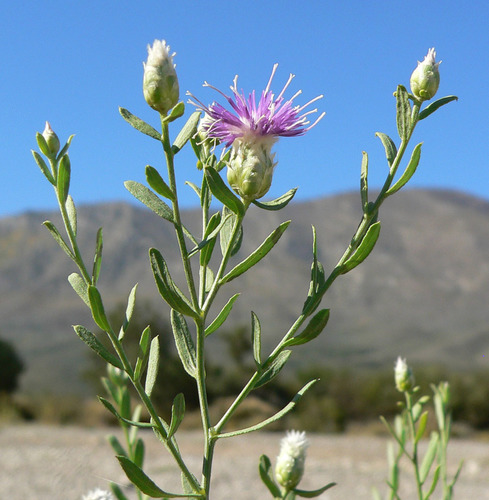
Leuzea repens, commonly called Russian knapweed, is a deep-rooted, long-lived perennial plant. Some established stands of this species have persisted for 75 years. It forms dense colonies in cultivated fields, orchards, pastures, and along roadsides, and grows up to 80 cm tall. Young stems and leaves have a fine, cobweb-like fuzzy covering, which fades as the plant ages, leaving the tissue smooth, green, and hairless. Rosette leaves are shaped like a reversed lance, ranging from unlobed (entire) to pinnately lobed, and measure 2–3 cm wide by 3–8 cm long. Lower leaves growing along the stem (cauline leaves) are smaller than rosette leaves and pinnately lobed; upper cauline leaves are much smaller, do not have a stalk (sessile), and range from toothed (serrate) to unlobed. Numerous flower heads form at the ends of branches. The flowers are pink to purplish, and the marginal flowers around the edge of each head are not larger than the inner flowers. The outer and middle bracts of the flower head's involucre are broad, marked with parallel stripes, smooth, and have broadly rounded tips; inner involucral bracts are narrower and have hairy tips. A pappus is present, made of bristles 6–11 mm long. The fruit is a whitish achene with slight ridges. Russian knapweed is native to Eurasia, and was introduced to North America in the late 19th century. It is absent only from the southeastern United States, and has become widespread across other regions of North America, especially the western United States. When horses eat Leuzea repens over prolonged periods, it causes nigropallidal encephalomalacia, also known as chewing disease, a movement disorder similar to Parkinson's disease. A sesquiterpene lactone called repin found in the plant is likely responsible for this toxicity.