About Leucosticte tephrocotis (Swainson, 1832)
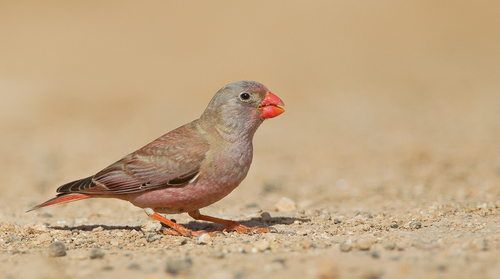
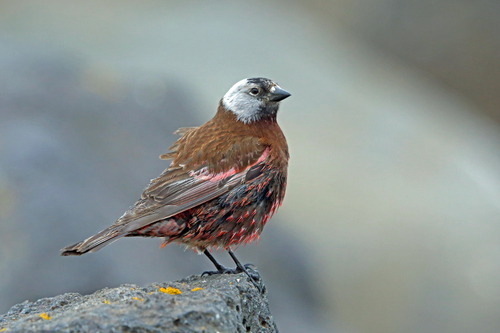
Leucosticte tephrocotis, the gray-crowned rosy finch, is a medium-large member of the finch family, with a comparatively long notched tail and wings. Adult gray-crowned rosy finches have brown backs and breasts, pink coloration on most of their remaining underparts and wings, black foreheads and throats, and gray color on the back of the head. They also have short black legs and a long forked tail. The amount of gray on the head varies between individuals, and the subspecies L. t. wallowa has an almost entirely gray head. Adult females and juveniles have similar appearance to each other. Overall, this species measures 140 to 160 mm (5.5–6.3 in) in length, has a 33 cm (13 in) wingspan, and weighs 22 to 60 g (0.78–2.12 oz). The Pribilof and Aleutian subspecies are about twice the size of other subspecies, measuring 170 to 210 mm (6.7–8.3 in) in length and weighing 42 to 60 g (1.5–2.1 oz). Compared to related species, the black rosy finch has a black body instead of brown, while the brown-capped rosy finch is a lighter brown and lacks the gray face patch. The ancestor of the three species of North American rosy finches migrated from Asia. All rosy finches live in alpine or tundra environments, and gray-crowned rosy finches are always found among rocks. Gray-crowned rosy finch has a wide range and large population across Alaska, western Canada, and the western United States, and its overall population is considered stable. Due to its remote alpine and tundra habitat, few of its nests have been found, and it is rarely spotted. Different subspecies occupy distinct ranges that rarely overlap during the breeding season, and males typically outnumber females throughout the year. The subspecies L. t. griseonucha is a permanent resident of the Aleutian Islands, and the subspecies umbrina is a permanent resident of the Pribilof Islands. A small number of gray-crowned rosy finches winter on the mainland in South-Central Alaska, where they may visit bird feeders. The other subspecies — littoralis, tephrocotis, wallowa, and dawsoni — occur in the Canadian and American Rockies, and migrate south to the western United States. L. t. tephrocotis summers across the range from Montana to the Yukon, while littoralis breeds closer to the coast, from northern California to west-central Alaska. One individual gray-crowned rosy finch was observed north of Boonville, Lewis County, New York from Sunday, March 4 through at least Thursday, March 8; this is only the second confirmed report of the species for New York State.