About Leucosticte nemoricola (Hodgson, 1836)
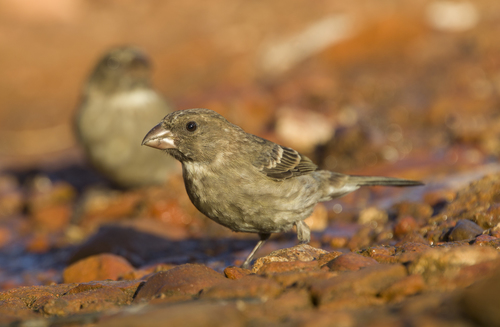
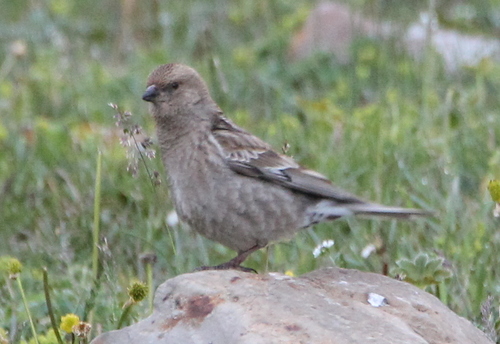
The Plain Mountain Finch, scientifically named Leucosticte nemoricola (Hodgson, 1836), measures 14–15 cm in length and weighs 18–25 g. It has a slender build, long wings, a notched tail, and a short pointed bill. Its head is buff brown with tawny streaks, its neck is beige, and the area around its eye and cheek is pale brown. Its mantle and back are dark brown with pale streaks, while its lower back is pale gray. Its tail and wings are dark brown with buff-brown and white markings. Adult males and females have identical plumage, and juveniles are paler with less distinct markings.
This species is distributed across Afghanistan, Bhutan, China, India, Kazakhstan, Myanmar, Nepal, Pakistan, Russia, Tajikistan, Tibet, and Turkmenistan. In the non-breeding season, it occupies high valleys, mountain forests, rocky cliff sides, fields, and towns. It is occasionally found at elevations up to 5300 m, more typically occurs around 2000 m, and may be driven down to 450–750 m during severe weather. Plain Mountain Finches may be permanent residents or altitudinal migrants.
Plain Mountain Finches usually sing from rocky outcroppings and boulders. Their song repertoire includes sharper twittering, and the distinct phrases "trit-tit-tit-tit", "rick-pi-vitt", and "dui-dip-dip-dip"; these phrases may be mixed with sweeter, warbling, musical notes. When in flight or in flocks, they produce a loud, dry "tchit-ti-tit" or a softer "chi-chi-chi-chi". Their diet consists of seeds from grasses and alpine herbs, as well as small invertebrates, and nestlings eat a mix of plant and animal food. These finches forage often and are typically unbothered by human presence, and are known to take human food scraps from encampments. While they can be seen alone, they usually form small flocks; in the non-breeding season, they gather in large flocks of 200 to 1000 individuals.
When courting to attract a breeding partner, a displaying male holds both wings straight up above his head, then runs toward observing females while giving excited calls. Females usually build nests in rocky holes and crevices around 2 m above ground, and occasionally nest underground in rodent burrows. Nests are shallow woven structures made from leaves, grasses, plant fibers, moss, roots, hair, and feathers. A female's clutch holds 3 to 6 eggs, which are either pure white or have a pale pinkish tint. The female incubates the eggs, and the male feeds her at the nest over an incubation period of 13 to 15 days. After hatching, both parents care for and feed the chicks. Common predators of Plain Mountain Finch chicks include foxes, dogs, stoats, copperhead snakes, and large snails. Adult finches face predation from these same species, plus birds of prey.