About Leucostele terscheckii (J.Parm. ex Pfeiff.) Schlumpb.
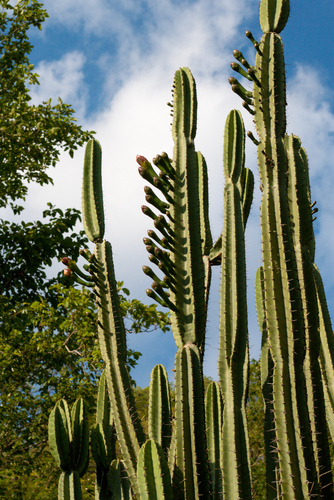
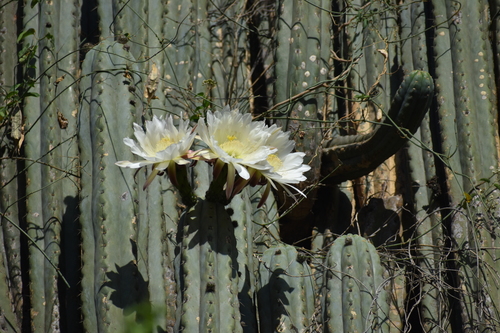
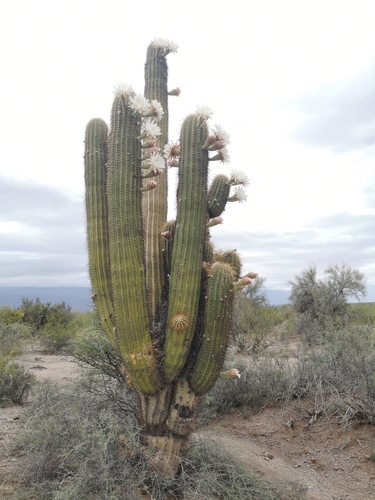
Leucostele terscheckii is a columnar, branching cactus that can grow to over 7.6 metres (25 ft) tall. Its branches are cylindrical, fleshy, and light green; diameter measurements given for its branches are roughly 10–25 cm (3.9–9.8 in), and branches have 8 to 14 blunt ribs. This species has large brownish areoles spaced about 2.5 cm (0.98 in) apart. Each areole bears 8 to 15 yellowish spines, 8.3–10 cm (3.3–3.9 in) long: there is one central spine, which is sometimes absent, and 8 to 15 radial spines. Its nocturnal, funnel-shaped white flowers can reach 15–20 cm (5.9–7.9 in) long and 13–15 cm (5.1–5.9 in) wide. The pericarp and flower tube have dense white or brown axillary hairs. The fruits are round or oblong, blue, and measure about 1.3 cm (0.51 in) in diameter. The fruits contain black to brown, oval seeds approximately 0.76 mm (0.030 in) long. This cactus is native to the northwestern Argentinian provinces of Jujuy, Tucumán, La Rioja, San Juan, Catamarca, and Salta. It is the eponymous cactus of Salta Province’s Los Cardones National Park. Its range extends further to the western slopes of the Andes in Peru, the Bolivian department of Tarija, and Ecuador. It grows on dry slopes of the Andean foothills at altitudes between 500 and 1500 meters. Leucostele terscheckii contains between 0.005% and 0.025% mescaline by fresh weight, and between 0.01% and 2.375% mescaline by dry weight. For this reason, dried Leucostele terscheckii is sometimes processed to produce mescaline hydrochloride.