About Leucospermum wittebergense Compton
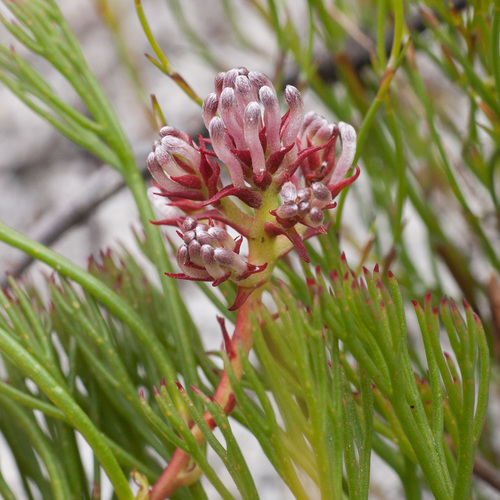
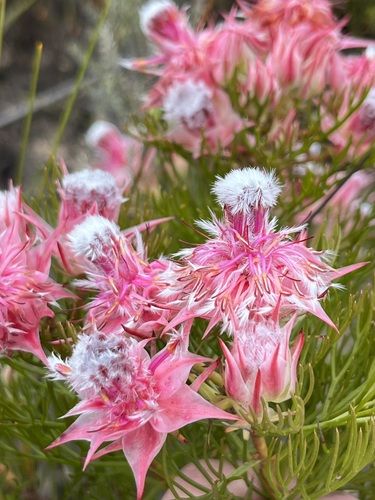
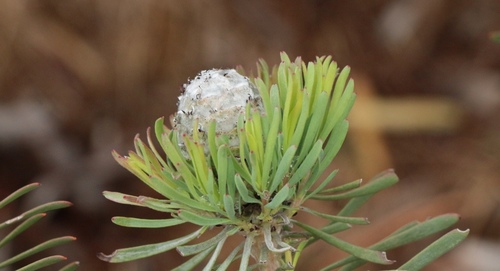
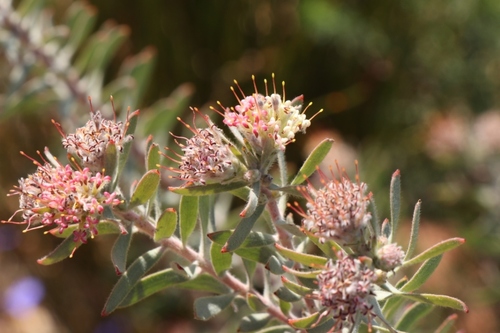
Leucospermum wittebergense Compton is an upright, heavily branching shrub, growing 0.5–1.5 m (1.7–5 ft) tall. Its upright flowering stems are round in cross-section, approximately 3 mm (0.12 in) in diameter, and mostly covered in scars left by fallen leaves. Its alternately arranged, overlapping leaves are oriented at an upward angle, range in color from grey to silvery, and are shaped from elliptic to lanceolate. Each leaf measures 1.5–2.5 cm (0.6–1.0 in) long and 3–6 mm wide, is covered in fine, crisp hairs, and has an entire margin. This species produces stalkless, globe-shaped flower heads around 2 cm (0.8 in) in diameter, which are usually borne individually. The common receptacle at the base of all flowers in a single head is shaped like an inverted cone with a flattened top, and is about 4 mm (0.16 in) wide. The bracts that subtend the entire flower head are closely overlapping, broadly lance-shaped with a pointed tip, around 4 mm long and 2 mm wide, covered in dense shaggy hairs, and have a cartilaginous texture. The bract that subtends each individual flower is carmine in color, inverted lance-shaped with a pointed tip, 6–7 mm long and 1–2 mm wide, and densely covered in woolly hairs. The 4-parted perianth is initially pale cream, develops a pink tint as it matures, is 1.5 cm (0.6 in) long, and remains straight in bud. The lower fused portion of the perianth, called the tube, is about 3 mm (0.12 in) long, hairless at the base but powdery textured further up, and has a slightly square cross-section. The middle portion of the perianth, called the claws, where all four lobes separate when the flower opens, is about 1 cm (0.4 in) long. The outer surface of the claws is pinkish carmine, and the inner surface is creamy yellow; they are thickly covered in shaggy hairs, curl back toward their base when flowers open, and the boundary between claws and limbs is not easily distinguishable. The upper portion of the perianth lobes, called the limbs, is elliptic in shape, thickly covered in shaggy hairs, and curves backward once the flower has opened. The style is 12–19 mm (0.48–0.76 in) long, thread-shaped, straight or very slightly curved, and pink to carmine in color. The slightly thickened tip of the style, called the pollen presenter, is yellow, shaped like a blunt cone that is sometimes slightly cleft, and around 1 mm (0.04 in) long. Four opaque, thread-shaped scales 0.5–0.7 mm long subtend the ovary. The flowers of Leucospermum wittebergense have a light, sweet scent. This species occurs from the Witteberg in the west, along the Swartberg, to a few miles east of Meirings Poort. It is also found on the Touwsberg and Warmwaterberg in the Little Karroo, and near Oudtshoorn on the northern slopes of the Outeniqua Range at Klein Moeras River. It grows exclusively on arid rocky slopes composed of Witteberg Quartzite or Table Mountain Sandstone, at altitudes between 750–1850 m (2500–6000 ft), on both north-facing and south-facing slopes. It is associated with arid Fynbos vegetation. Populations on the Swartberg grow up to 1.5 m (5 ft) tall and receive up to 635 mm (25 in) of average annual precipitation, while plants growing on the Witteberg are mostly no taller than 0.5 m, and receive only 250 mm (10 in) of annual precipitation on average. This species, commonly called the Swartberg pincushion, does not survive the periodic natural wildfires that occur in the fynbos it inhabits. Its relatively small flowers are pollinated by bees and flies. Fruits ripen around two months after flowering, then fall to the ground. Native ants collect the fallen fruits and carry them back to their underground nests, where they eat the nutrient-rich elaiosome attached to the seed. The hard, smooth remaining seed stays stored underground, where it cannot be removed, and remains dormant until it germinates after fire and rain.