About Leucospermum vestitum (Lam.) Rourke
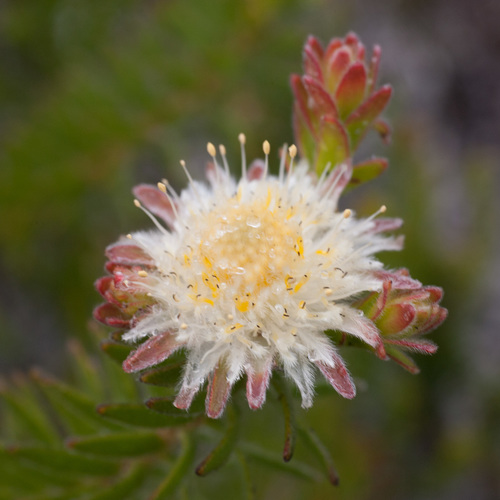
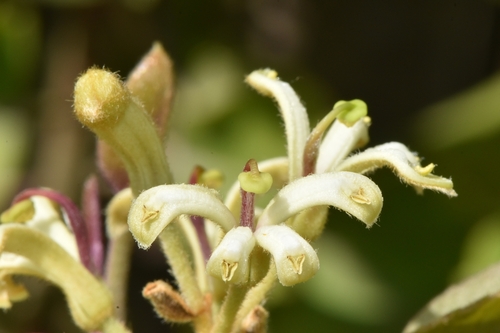
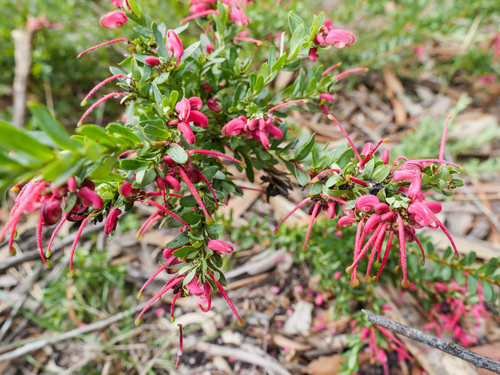
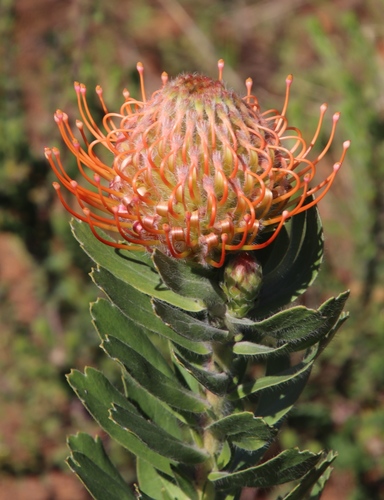
Leucospermum vestitum is a stiff, evergreen shrub that grows upright to spreading, reaching up to 2½ m (9 ft) high and 3 m (10 ft) in diameter. It grows from a single stout stem with smooth grey bark. Its flowering stems are 5–8 mm (0.20-0.32 in) in diameter, stiffly upright to horizontally spreading, and have a thin covering of powdery hairs. The sessile, hairless leaves are oblong, elliptic or narrowly oval, 5–7½ cm (2–3 in) long and 1–3 cm (0.4–1.2 in) wide. Leaves have truncated or heart-shaped bases, pointed tips or two to four teeth at the tip, and are arranged alternately in a somewhat overlapping pattern. The flower heads are egg- to globe-shaped, 7–9 cm (2.8–3.6 in) in diameter, and mostly borne individually on flowering branches. The common receptacle for all flowers in a single head is very narrowly cone-shaped with a pointed tip, 4–5 cm (1.6–2.0 in) long and ¾–1 cm (0.3–0.4 in) across. The bracts that subtend the entire flower head are broadly oval with a pointed to sharp tip, 1–1½ cm (0.4–0.6 in) long and ½–1 cm wide. They are loosely spreading, membranous, hairless, pale green and shiny, with a regular row of hairs along the edge. The bract subtending each individual flower is pointed oval, membranous, and wraps around the base of the flower. It measures around 1½ cm long and 5–7 mm wide, is hairless or has a very fine powdery covering, and has a row of hairs along its edge. The 4-merous perianth is around 3½ cm (1.4 in) long, initially orange, changing to brilliant carmine as it ages. The lower, merged portion of the perianth, called the tube, is around 6 mm (¼ in) long, cylinder-shaped, somewhat compressed sideways, and hairless. The middle segments (or claws) are crescent-shaped and coil back toward the base. The claw facing the center of the flower head is hairless; the two sideways-facing claws have protruding silky hairs; and the claw facing the edge of the head is entirely covered in protruding silky hairs. The upper segments (or limbs), which enclose the pollen presenter within the bud, are oval, each 4–5 mm (0.16–0.2 in) long, and covered with long protruding silky hairs. An oval anther around 3 mm (0.12 in) long, on a filament around 1.0 mm (0.04 in) long, is attached to the inner surface of each of the four limbs. A slender tapering style 5–6 cm (2.0–2.4 in) long emerges from the center of the perianth, and curves toward the center of the head in its upper third. The thickened tip of the style, called the pollen presenter, is yellow, offset, egg-shaped with a pointed tip, around 3 mm (0.12 in) long. The groove that acts as the stigma sits on a raised papilla at the very tip of the pollen presenter. The ovary is subtended by four white, blunt, line-shaped scales 1½–2 mm (0.06–0.08 in) long. This species, commonly called silky-haired pincushion, occurs between Heerenlogementberg (halfway between Klawer and Graafwater) in the north, through the Clanwilliam, Ceres, Piketberg and Tulbagh districts, to the Breede River Valley several kilometers north of Worcester in the south. It was collected three times on the Cape Peninsula (at Table Mountain, Lion's Head and Green Point) but appears to have been extirpated from this area since 1886. It has also gone extinct on Paarl Mountain, near Paarl. Silky-haired pincushion grows in a range of ecological conditions, always on well-drained rocky slopes of Table Mountain Sandstone. It occurs at altitudes from 70–1400 m (200–4000 ft), most often on north- or west-facing slopes. It is very tolerant of drought, which is common in the arid fynbos it inhabits, where average annual precipitation can be as low as 250 mm (10 in). In the Tulbagh valley, plants mostly have a stiff upright growth habit, while more northerly populations tend to have more sprawling shrubs. The flowers of Leucospermum vestitum are pollinated by birds such as the Cape sugarbird and several sunbird species, which visit to feed on nectar. When fruits ripen, around two months after flowering, they fall to the ground. Their fleshy pale coating, called an elaiosome, attracts ants. Ants carry the fruits back to their nests and eat the elaiosome, leaving the smooth, hard seeds underground; the seeds are too large to fit inside the ants' jaws, so they are stored safely. Mature plants are killed by the wildfires that naturally occur in their native fynbos habitat. Seeds germinate in response to increased daily temperature fluctuations after overlying vegetation is removed by fire, and from chemicals that leach out of ash during winter rains, allowing the local population to regenerate. L. vestitum is one of several Leucospermum species used as a cut flower, particularly because it combines showy flower heads with long straight stems. It is also used as a parent to develop Leucospermum hybrids suited for both garden cultivation and the cut flower trade.