About Leucospermum truncatulum (Knight) Rourke
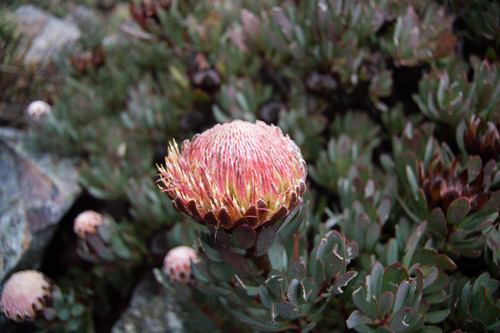
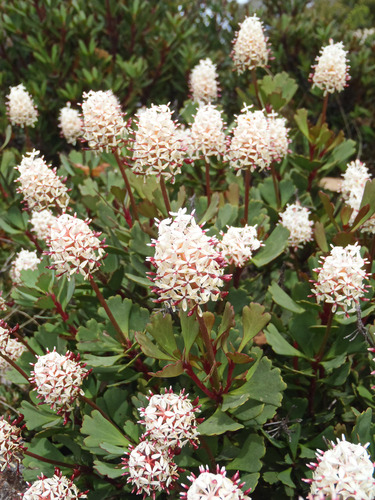
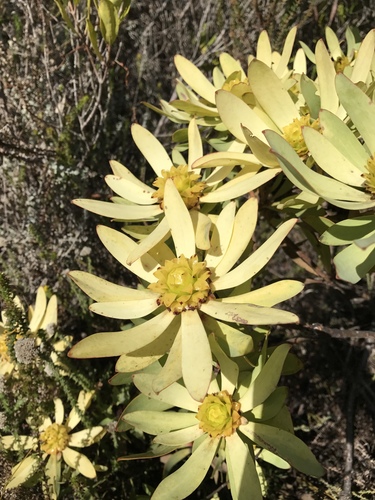
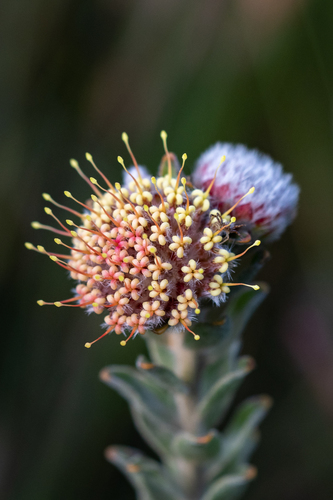
Commonly called the oval-leaf pincushion, Leucospermum truncatulum (Knight) Rourke is a slender, stiffly upright, very sparsely branching evergreen shrublet. It usually grows 1 to 1½ meters tall, occasionally reaching up to 2 meters (6 feet), and grows from a single basal stem. Its flowering stems are slender, 3–4 mm (0.12–0.16 in) in diameter, and densely covered in soft hairs. For a Leucospermum species, it has small leaves that are rounded egg-shaped to oval, with entire margins. The leaves measure 1–2½ cm (0.4–1.0 in) long and ½–1 cm (0.2–0.4 in) wide, are densely overlapping, and covered with fine silky hairs. Its flower heads are globe-shaped, 1½–2 cm (0.6–0.8 in) in diameter, stalkless, and usually crowded in groups of two to eight near the tips of stems. The common base that all flowers in a single head attach to is flat and 4–5 mm in diameter. The bracts that subtend the entire flower head are arranged in three or four whorls; each bract is broadly lance-shaped to oval, with a pointed or blunt tip, 5–7 mm (0.20–0.28 in) long and 2–5 mm (0.08–0.20 in) wide. They have a papery texture, carry a thin tuft of long straight hair at the tip, have a regular row of straight hairs along the margin, and are otherwise hairless. The bracts subtending each individual flower are lance-shaped with a pointed tip, about 6 mm (0.24 in) long and 2 mm (0.08 in) wide, and are densely covered in woolly hairs. The perianth is initially yellow, but fades to pinkish over time, and is 8–10 mm (0.32–0.40 in) long. When the flower opens, it leaves behind a hairless, slightly quadrangular tube 4 mm (0.16 in) long, while the four lobes, which are covered in soft hairs, curl backward. The uppermost section of the perianth is made of oval lobes around 2 mm (0.08 in) long, with very few rough hairs. The styles are 1.4–1.6 cm (0.56–0.64 in) long, straight to slightly curved toward the center of the flower head, and taper toward the tip. They start out yellow, and age to crimson. The thickened tip of the style, called the pollen presenter, is abruptly cone-shaped to egg-shaped with a pointed tip, around 1.0 mm (0.04 in) long, and has a groove that acts as the stigma at the very center of the tip. The ovary is subtended by four opaque, threadlike scales with a blunt tip, around 1½ mm (0.06 in) long. The flowers of Leucospermum truncatulum have a slight scent. This species occurs from the eastern foothills of Kogelberg Peak in the west, south along the Bot River, along the coast from Hermanus to almost reach Cape Agulhas in the southeast of its range, and north to Bredasdorp, extending northwest via Caledon. Plants mostly grow in large, extensive stands. Across its distribution, average annual precipitation is between 650 and 1000 mm (25–40 in), with most rain falling during the winter half of the year. The species prefers acidic, nutrient-poor sands on east- and south-facing slopes from sea level up to around 365 m (1200 ft). It grows in dense sclerophyll vegetation, which is mostly made up of other Proteaceae, Ericaceae, and the grass-like Restionaceae. The oval-leaf pincushion is pollinated by insects, including bees and flies. Fruits ripen around two months after flowering, then fall to the ground. Ants gather the fallen fruits, attracted by a pale fleshy elaiosome (also called an ant loaf) on the seed, and carry the seeds back to their underground nests. The ants eat the elaiosome, but leave the seeds stored safely underground, a seed dispersal strategy called myrmecochory. When wildfires, which naturally occur in Fynbos every decade or two, kill all above-ground plant growth, chemicals from charred vegetation percolate into the soil with rainwater, triggering the stored seeds to germinate and regenerate the population. Seeds also require night temperatures of 4–10 °C (39–50 °F) and day temperatures of 15–20 °C (59–68 °F) to germinate, conditions that are typical of autumn in the species' native range, and signal the arrival of heavy winter rains.