About Leucospermum tomentosum (Thunb.) R.Br.
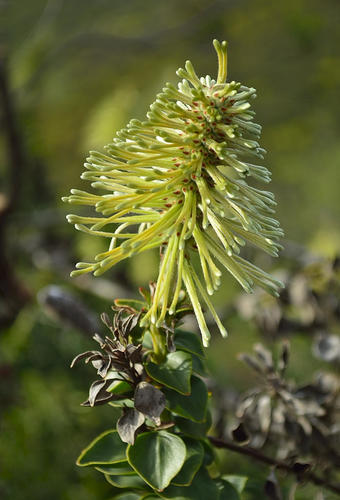
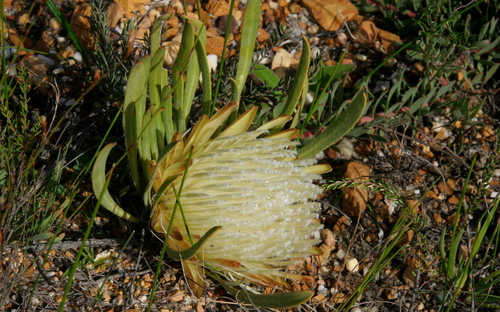
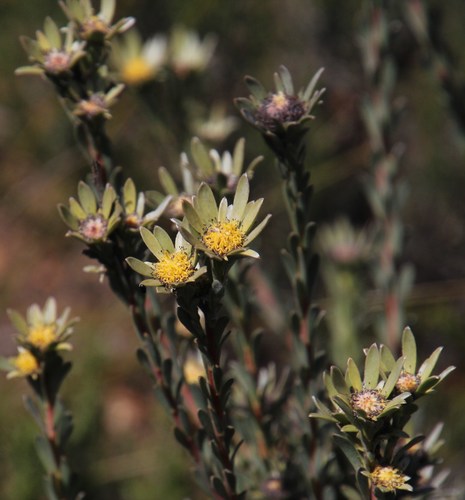
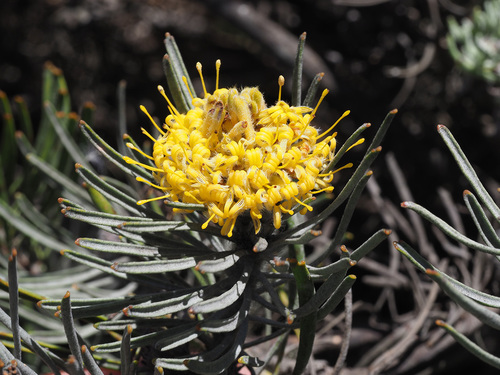
Leucospermum tomentosum (Thunb.) R.Br., sometimes referenced as Leucodendron tomentosum, is an evergreen shrublet that grows 0.4–1.0 m (1.3–3.3 ft) high and 0.5–3 m (1.7–10 ft) in diameter. It initially produces upright, spreading branches; over time, these branches become weighted down by their own growth, develop roots where they touch sand, and new branches emerge from these rooted points. It has a stout underground rootstock covered in a thick layer of bark that provides extra protection against fire. Main branches are stout, woody, and 2–5 cm (0.79–1.97 in) in diameter. Flowering stems range from upright to erect to spreading, are 4–6 mm (0.16–0.24 in) in diameter, and are covered in dense, short, crinkly grey felty hairs, plus some longer, thin upright hairs. The grey felty leaves are line-shaped, 4.5–6 cm (1.8–2.4 in) long and 3–5 mm (0.12–0.20 in) wide. They may have no teeth or up to three teeth at the tip, with a gradually narrowing base, and inward-curled edges that give leaves the shape of a tube segment. Leaves are alternately arranged, point somewhat upward, and overlap closer to the tips of branches. Globe-shaped flower heads are 3–3.5 cm (1.2–1.4 in) in diameter, stalkless, and grow in groups of one to four. The common shared base of all flowers in a single head is low cone-shaped, about 1.3 cm (0.51 in) long and 1 cm (0.39 in) wide. This base is subtended by pointed lance-shaped bracts around 5 mm (0.20 in) long and 3 mm (0.12 in) wide; the bracts are cartilaginous, tightly pressed and overlapping, covered in short soft hairs, and have a tuft of long grey hairs at their tip. Bracts subtending each individual flower are line-shaped, 5–7 mm (0.20–0.28 in) long, embrace the flower base, have a regular row of hairs along the edge, a pointed tip, and soft hairs on their outer surface. The 4-merous perianth is around 2 cm long, straight when in bud, tube-shaped, and entirely deep yellow. The lower merged portion that remains when the flower opens, called the tube, is 4–5 mm (0.16–0.20 in) long, hairless, and somewhat flattened sideways. The middle portion, called the claws, where the perianth splits lengthwise, is 2–3 mm (0.079–0.118 in) long; the segment facing the center of the flower head is hairless, while the other segments have very short hairs. This middle portion is barely differentiated from the upper portion, called the limbs, which encloses the pollen presenter in the bud, is roughly hairy on the outside, and loses hairs as it ages. A straight, slender yellow style 1.75–2 cm (0.69–0.79 in) long emerges from the center of the perianth. The thickened tip of the style, called the pollen presenter, is cylinder-shaped or narrowly elliptic, 1.5–2 mm (0.06–0.08 in) long, and has a stigma groove that sits across the very tip. The ovary is subtended by four opaque, line- to awl-shaped scales around 1 mm (0.039 in) long. The flowers of Leucospermum tomentosum are sweetly scented. The genus Leucospermum is part of the subtribe Proteinae, which consistently has a basic chromosome number of twelve, with a diploid count of 2n=24.
Commonly called the Saldanha pincushion, this species grows widely scattered across sandveld within 5 km (3.1 mi) of the Atlantic coast of South Africa, ranging from Bok Bay near Atlantis, Western Cape in the south, to the sandy flat between Vredenburg and Hopefield, Western Cape. Just one isolated population near Mud River farm sits around 10 km (6.2 mi) from the coast. Across its distribution, average annual precipitation is 250–375 mm (64–95 mm, the original source contains a unit error listing 250–375 inches), which falls almost entirely during the southern winter. It grows individually in very open vegetation on bare sand, alongside shrubs such as Metalasia and Passerina, and large clumps of Restionaceae. The species regenerates reasonably well from its underground rootstock after fire, which naturally occurs in strandveld and sand fynbos roughly every ten to twenty years.