About Leucospermum praecox Rourke
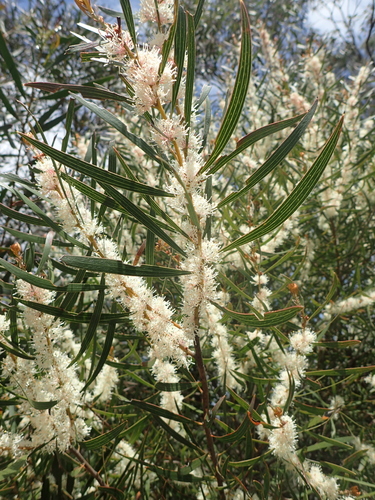
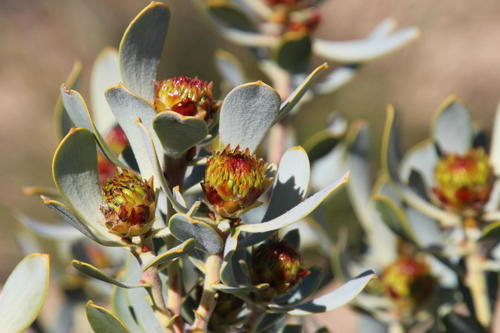
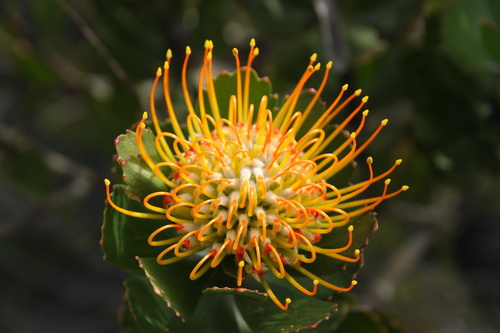
Leucospermum praecox Rourke, commonly called the Mossel Bay pincushion, is an upright, rounded shrub that reaches 2–3 m (6–9 ft) in height and up to 4 m (12 ft) in diameter. It has a stout main stem that grows up to 8 cm (3.2 in) in diameter, with branches covered in smooth grey bark. Flowering branches are round in cross-section, ½–1 cm (0.2–0.4 in) in diameter, covered with a dense greyish layer of felty, crisped hairs pressed to the surface, mixed with some long silky hairs. Its hairless leaves are inverted egg-shaped or broadly wedge-shaped, 3½–7 cm (1.4–2.8 in) long and 1½–3 cm (0.6–1.2 in) wide, with 6 to 11 teeth near the tip; they point slightly upwards and are somewhat overlapping. Flower heads are stalkless and grow in the axil of a leaf, are globe-shaped, 6 cm (2.4 in) in diameter, with up to four heads per flowering stem. The common base that all flowers in a single head attach to is broadly cone-shaped, about 2 cm (0.8 in) high and 1½ cm (0.6 in) wide. This base is surrounded by an involucre of oval bracts with pointed tips, each around 0.8 cm (0.32 in) long and ½ cm (0.2 in) wide. These bracts are rubbery in texture and densely covered in soft grey hairs. The bracts that subtend individual flowers are inverted egg-shaped with a sharply pointed tip, about 1 cm (0.4 in) long and ½ cm (0.2 in) wide, thickly woolly at the base and rubbery in texture. The perianth is around 3 cm (1.2 in) long; it is yellow when the flower opens, and turns orange as it ages. The lower fused section of the perianth, called the tube, is 6–8 mm (0.24–0.32 in) long, hairless and narrow at its base, finely powdery and swollen further up, and narrows suddenly again where the middle section of the perianth begins. The middle section of the perianth, where at least one lobe becomes free when the flower opens and called the claws, is pale yellow, curves back near its upper end, and covered in fine powdery hairs. The upper section of the lobes, called the limbs, is narrowly lance-shaped, ½ cm (0.2 in) long, covered with long soft silky hairs on the outside, and holds the nearly stalkless anther. The style is initially pale yellow, turns orange as it ages, is 3.8–4.8 cm (1.5–1.9 in) long, and curves toward the center of the flower head. Its slightly thickened tip, called the pollen presenter, is narrowly cone-shaped with a pointed tip, about 3 mm (0.12 in) long. Four opaque, rubbery, awl-shaped scales around 3 mm long subtend the ovary. This species occurs in a small range from Mossel Bay in the east to the mouth of the Gouritz River, just west of Albertinia, extending south from the line connecting these two points to the coast. Within this range, it is locally common and forms several very dense stands, though an invasive alien Hakea species is encroaching on its habitat. At Mossel Bay, L. praecox grows on weathered Table Mountain Sandstone; elsewhere it only grows on deep stabilised white acidulous sands deposited between the Tertiary period and recent times, located on the fore coast. L. praecox has an unusual flowering period, beginning in April (fall in the southern hemisphere) and lasting until early spring in September.