About Leucospermum pluridens Rourke
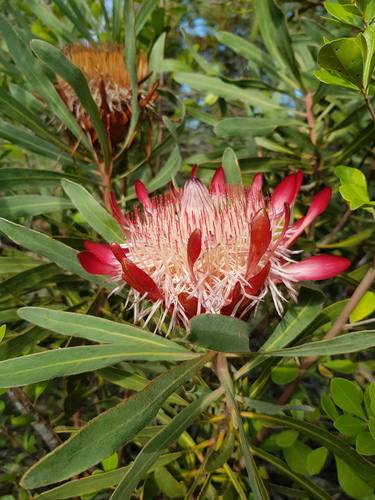
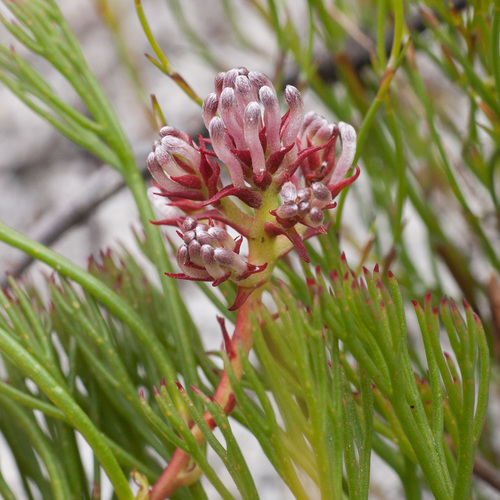
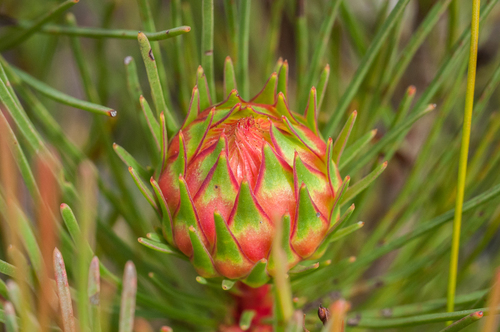
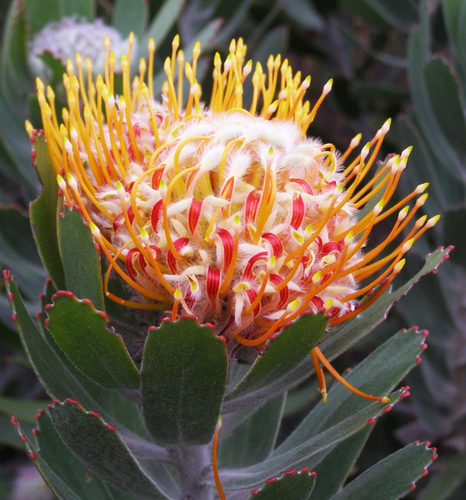
Leucospermum pluridens, scientifically named Leucospermum pluridens Rourke, is an upright, rigid, evergreen tree-like shrub that can reach up to 3 m (9.8 ft) in diameter. It grows from a woody trunk of up to 20 cm (7.9 in) in diameter, which along with lower branches is covered in smooth grey bark. Characteristically, young plants branch only sparsely from their stiff upright stems, while older plants develop more branches. Flowering branches are stout and woody, measuring 3⁄4–1 cm (0.3–0.4 in) across, with a thick grey felty or spiderweb-like covering made of short crinkled hairs. Leaves are arranged alternately, slightly overlapping, hairless and leathery, and shaped oblong, broadly inverted lance-shaped, or wedge-shaped. They are 5+1⁄2–10 cm (2.2–3.9 in) long and 2–3+1⁄2 cm (0.79–1.38 in) wide. The leaf tip is rounded, often deeply incised, and bears seven to ten very prominent rounded teeth. Flowerheads are egg-shaped, about 8 cm (3+1⁄4 in) high and 6 cm (2.4 in) across. They are either seated or have a very short stalk, most often growing individually but sometimes occurring in groups of up to four on a single flowering branch. The common base of the flowers within one head is narrowly cone-shaped with a pointed tip, 3+1⁄2–4 cm (1.4–1.6 in) long and about 1 cm (0.39 in) wide. Bracts subtending the entire head are oval, keeled, with a very long narrowing, hook-shaped tip up to 2 cm (0.79 in) long. They have a row of long hairs along their edges, and their inner surface is shiny and carmine-coloured in living specimens. The bract subtending each individual flower is cartilaginous, keeled, and wraps around the flower base, about 1 cm long and 6 mm wide. It has a long pointed tip that curves slightly inward, with a row of long hairs along the edges. The perianth is 4-merous. The lower merged portion of the perianth, called the tube, is about 10 mm (0.39 in) long, cylinder-shaped, somewhat sideways compressed, hairless at its base and slightly powdery higher up. The middle portions, or claws, are initially yellow, turning bright carmine, with rough hairs on the inner surface that mix long straight hairs with short felty hairs. The claw facing the center of the flowerhead is hairless near its base. The upper portions, or limbs, which enclose the pollen presenter within the bud, are broadly lance-shaped with a pointed tip, each about 5 mm long and 2 mm wide, and covered in felt. Limbs facing the head center and sides also have additional long silky hairs, while the limb facing the edge of the head is less densely felty than the other three. A slender tapering style emerges from the center of the perianth, 5–6 cm (2.0–2.4 in) long and about 1½ mm thick, with its upper portion slightly curved toward the center of the head. The thickened tip of the style, called the pollen presenter, is orange on its lower half and yellow on its upper half, cone-shaped with a pointed tip. It is about 2 mm (0.079 in) long and 1 mm wide, with a green stigma groove running across its very tip. The ovary is subtended by four white, awl-shaped scales about 2 mm (0.079 in) long. The common name of this species is Robinson pincushion. It grows on the lower northern slopes of the Outeniqua Mountains near "Klein Moeras Rivier Spruiten", Saffraan Rivier and Kruis Pad, at an altitude of 500–600 m (1,600–2,000 ft), and on the southeastern slopes of the Rooiberg at an altitude of 750–1,050 m (2,460–3,440 ft). It also grows in the Baviaanskloof. At both of its main locations, the species occurs in Arid Fynbos, a transitional vegetation type at the interface between fynbos and Karoo. This is most evident at Kruis Pad, where this species grows alongside Aloe ferox, several species of Cotyledon, Elytropappus, and Restionaceae on dry, hot, north-facing hills. Within its distribution, average annual precipitation is 250–400 mm (10–15 in), which makes its moisture requirements quite different from those of its close relative L. glabrum. Fruits ripen about two months after flowering, then fall to the ground. Ants gather the fallen fruits and carry them to their underground nests, where the seeds remain until they germinate after a fire removes the overhead vegetation cover.